
Architecture shapes the way we experience the world – from the soaring dome of St Paul’s Cathedral, which we’re fortunate enough to see in our London neighborhood, to the shimmering titanium curves of the Guggenheim Bilbao, which took our breath away on a trip to Spain’s Basque Country.
In this guide, we celebrate the most famous architects in history and explore the iconic buildings that define their legacies. Whether you’re an architecture enthusiast, a design student or a traveler seeking out the world’s most remarkable structures, this list covers the visionaries who have shaped our built environment over the centuries.
From the organic forms of Antoni Gaudi’s Barcelona to the gravity-defying curves of Zaha Hadid, these architects have each left a lasting mark on civilization. Many of the buildings featured here are ones we’ve had the privilege of visiting during our travels to over 37 countries.
What Is Architecture?
Architecture is the art and science of designing and constructing buildings and other physical structures. It encompasses everything from grand cathedrals and skyscrapers to private homes and public spaces.
Architecture is different from landscape architecture, which focuses on the design of outdoor spaces such as parks and gardens. Landscape architects often work with architects to create a unified aesthetic for a building and its surroundings.
Great architecture can inspire, comfort and uplift us, while poor design can have the opposite effect. The architects on this list understood that truth profoundly, and their works continue to move people around the world.
How We Chose These Famous Architects
We’ve spent over a decade visiting architecturally significant buildings across five continents. Our selection criteria for this list include: historical significance and lasting influence on the field, innovation in design, materials or construction techniques, the cultural impact of their most famous works, and recognition through major awards such as the Pritzker Architecture Prize.
Where possible, we’ve included personal observations from our own visits to these architects’ buildings – from walking beneath the Louvre Pyramid in Paris to exploring Gaudi’s masterworks in Barcelona. This first-hand experience informs our perspective on why these architects truly matter.
List of The Most Famous Architects in the World
Over the centuries, some of the world’s most talented architects have designed truly iconic buildings and structures. From classical designs to contemporary masterpieces, these architects have made their mark on history. Let’s explore their work.
1. Frank Lloyd Wright (1867-1959)
Frank Lloyd Wright was one of the most famous and influential architects of the 20th century. Over a career spanning seven decades, he designed more than 1,000 structures, with over 500 completed. He is best known for his Prairie Style homes, which were designed to harmonize with the natural landscape – a philosophy he called organic architecture.
Wright believed that buildings should grow naturally from their surroundings, and this ethos produced some of the most celebrated structures in American architecture.
Most famous works:
- Robie House (Chicago, Illinois) – Considered one of the finest examples of Prairie Style architecture
- Fallingwater (Mill Run, Pennsylvania) – A house built dramatically over a waterfall, now a UNESCO World Heritage Site and National Historic Landmark
- Solomon R. Guggenheim Museum (New York City) – A spiraling cylindrical masterpiece on Fifth Avenue, revolutionizing museum design
- Taliesin West (Scottsdale, Arizona) – Wright’s winter home and studio, built from desert rocks and concrete

2. Antoni Gaudi (1852-1926)
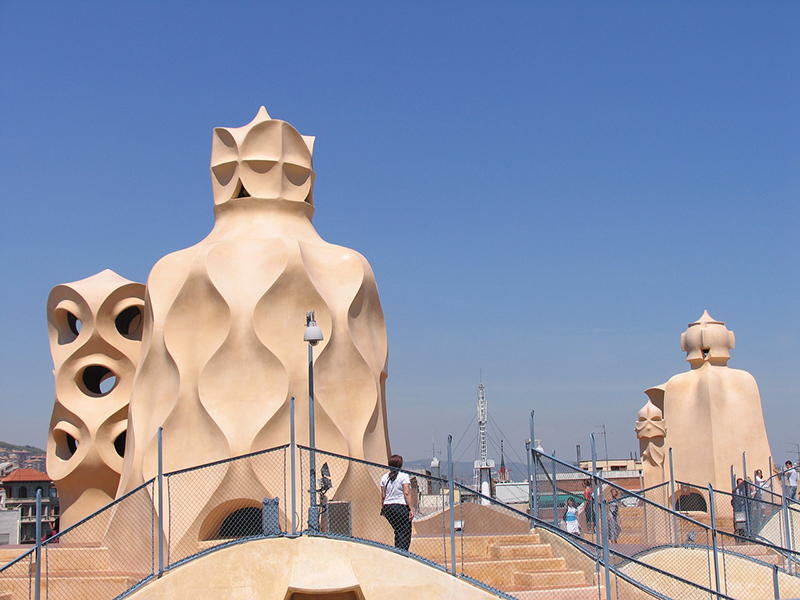
Antoni Gaudi was a visionary Spanish architect born in Reus, near Barcelona. He is the undisputed master of Catalan Modernism, and his whimsical, nature-inspired designs have made Barcelona one of the world’s most architecturally fascinating cities.
We’ve explored several of his buildings in person, and the level of organic detail in every surface is extraordinary – nothing quite prepares you for seeing it up close. Much of Gaudi’s work was inspired by natural forms, incorporating curves, organic shapes and vibrant mosaics. He once said that the straight line belongs to man, but the curve belongs to God.
Most famous works:
- Casa Mila / La Pedrera (Barcelona) – An undulating apartment building with a rooftop featuring surreal chimney sculptures
- La Sagrada Familia (Barcelona) – His unfinished masterpiece basilica, under construction since 1882 and expected to be completed in 2026
- Park Guell (Barcelona) – A public park featuring mosaic-covered structures and serpentine benches with panoramic city views
- Casa Batllo (Barcelona) – A remodeled residential building with a skeletal facade and dragon-scale roof
3. Zaha Hadid (1950-2016)
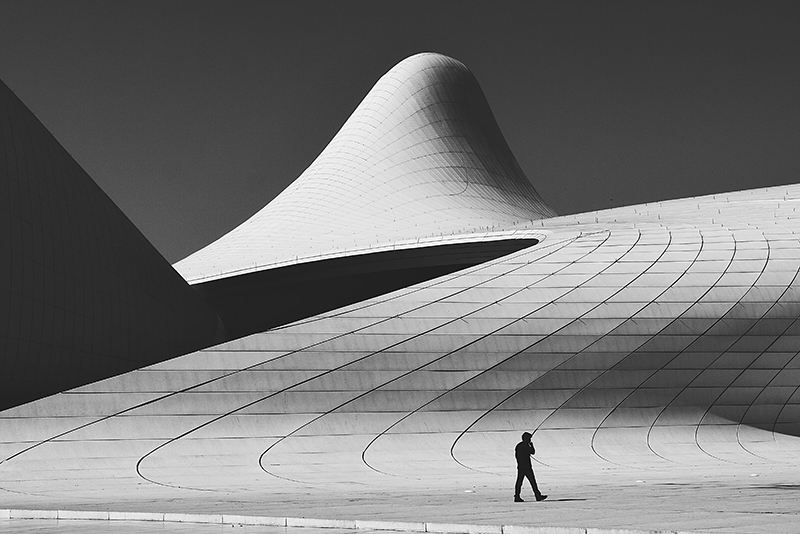
Zaha Hadid was a British-Iraqi architect who became famous for her futuristic and often gravity-defying designs. Nicknamed the Queen of the Curve, many of her structures don’t have a single right angle. She was the first woman to receive the Pritzker Architecture Prize in 2004 and won the Stirling Prize in both 2010 and 2011.
Hadid’s practice, Zaha Hadid Architects, continues her legacy today and remains at the forefront of computational design and parametric architecture.
Most famous works:
- Antwerp Port House (Antwerp, Belgium) – A faceted glass extension perched atop a historic fire station
- Heydar Aliyev Centre (Baku, Azerbaijan) – A flowing white building that rises and folds like a wave, with no sharp angles in sight
- London Aquatics Centre (London, UK) – Built for the 2012 Olympics, its sweeping wave-shaped roof is a London landmark
Guangzhou Opera House (Guangzhou, China) – Resembling two pebbles on the banks of the Pearl River
4. Le Corbusier (1887-1965)
Charles-Edouard Jeanneret, better known as Le Corbusier, was a Franco-Swiss architect and urban planner considered one of the pioneers of modern architecture. He championed the idea that form follows function and developed his Five Points of Architecture, which influenced generations of designers.
Le Corbusier is famous for his innovative use of reinforced concrete and his designs which incorporate natural light into their interiors. Seventeen of his buildings across seven countries are collectively designated as a UNESCO World Heritage Site.
Most famous works:
- Chandigarh Capitol Complex (Chandigarh, India) – A monumental government complex and UNESCO World Heritage Site
- Villa Savoye (Poissy, France) – A masterpiece of the International Style, raised on pilotis with a rooftop garden
- Notre Dame du Haut (Ronchamp, France) – A Roman Catholic chapel with dramatically curved walls and a sweeping concrete roof
- Unite d’Habitation (Marseille, France) – A pioneering social housing block that influenced Brutalist architecture worldwide

5. Frank Gehry (1929-2025)
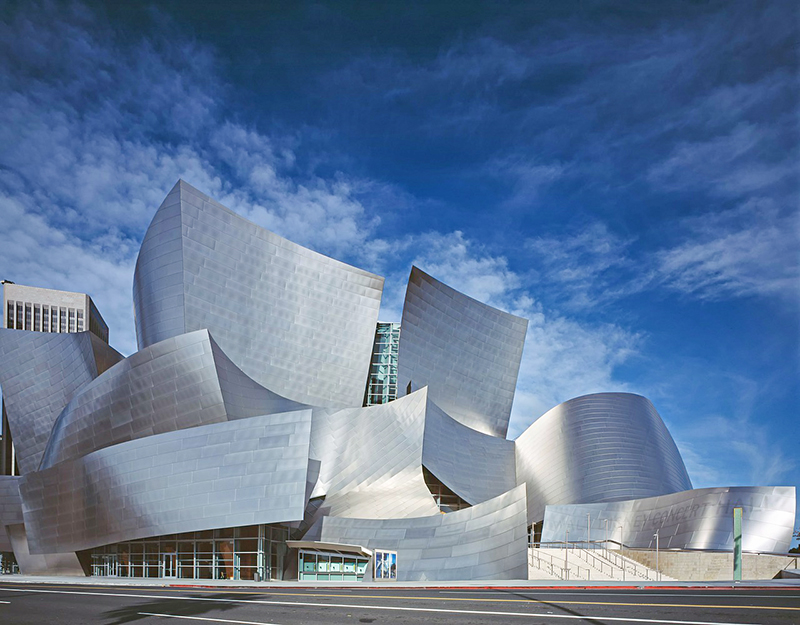
The late, great Frank Gehry was a Canadian-American architect famous for his unique and often controversial deconstructivist designs. A leading light of Deconstructivism – characterized by fragmentation and flowing, sculptural forms – he redefined what a building could look like.
We visited the Guggenheim Bilbao on a trip to Spain’s Basque Country, and its shimmering titanium panels are mesmerizing in the flesh. The building single-handedly revitalized the city’s economy – a phenomenon known as the Bilbao Effect. It’s listed in our guide to famous European landmarks.
Most famous works:
- Guggenheim Museum Bilbao (Bilbao, Spain) – Titanium-clad masterpiece that transformed a struggling industrial city into a global arts destination
- Walt Disney Concert Hall (Los Angeles, USA) – Stainless steel curves housing a world-class concert venue
- Louis Vuitton Foundation (Paris, France) – A glass-sailed contemporary art museum in the Bois de Boulogne
He also co-designed The Dancing House (also known as Fred and Ginger) in Prague with Croatian-Czech architect Vlado Milunic.
6. Norman Foster (b. 1935)
Norman Foster is a British architect known for his high-tech, modernist designs that merge engineering innovation with striking aesthetics. As a London resident, we see his work almost daily – The Gherkin (30 St Mary Axe) is a fixture on the City skyline, and we’ve crossed his Millennium Bridge many times on walks from Tate Modern towards St Paul’s Cathedral.
His buildings are consistently among the most expensive in the world to construct. Foster + Partners, his architectural practice, has designed some of the most recognizable buildings of the late 20th and early 21st centuries, with a strong emphasis on sustainability.
Most famous works:
- Millennium Bridge (London, UK) – A pedestrian steel suspension bridge spanning the Thames, initially nicknamed the Wobbly Bridge
- 30 St Mary Axe / The Gherkin (London, UK) – An iconic bullet-shaped skyscraper in the City of London financial district
- Reichstag Dome (Berlin, Germany) – A stunning glass dome atop Germany’s parliament building, symbolizing transparency in government
- Apple Park (Cupertino, California) – The ring-shaped headquarters of Apple, one of the most expensive buildings ever constructed at $5 billion

7. Renzo Piano (b. 1937)
Renzo Piano is an Italian architect who has designed some of the most famous buildings in the world. Living in London, we see The Shard almost every day – it’s visible from many parts of the city and is a defining feature of the modern London skyline.
Piano also co-designed the Centre Georges Pompidou in Paris with Richard Rogers. In 1998, he was awarded the Pritzker Prize. You can spot many of these buildings on our list of famous London landmarks.
Influenced by his family’s building background in Genoa, Piano’s works focus on accessibility, lightness and harmony with nature.
Most famous works:
- The Shard (London, UK) – Western Europe’s tallest building at 310 metres, with a distinctive glass pyramidal form
- Centre Georges Pompidou (Paris, France) – A radical inside-out building with exposed pipes and escalators, co-designed with Richard Rogers
- Zentrum Paul Klee (Bern, Switzerland) – Three undulating wave-like steel forms housing the world’s largest collection of Paul Klee’s works
- Whitney Museum of American Art (New York City) – An asymmetric building in the Meatpacking District with cascading outdoor terraces

8. I.M. Pei (1917-2019)
Ieoh Ming Pei was a Chinese-American architect famous for his bold geometric designs in glass and steel. We’ve admired the Louvre Pyramid on many visits to Paris – initially controversial, it’s now recognized as one of the city’s great modern landmarks. Read more about our favorite things to discover in the French capital in our guide to hidden gems in Paris.
Pei integrated geometric patterns such as circles, squares and triangles throughout his work. He lived to the remarkable age of 102.
Most famous works:
- Louvre Pyramid (Paris, France) – A glass and metal pyramid serving as the main entrance to the Louvre Museum
- John F. Kennedy Presidential Library (Boston, USA) – A striking concrete and glass structure overlooking Dorchester Bay
- Bank of China Tower (Hong Kong) – A 72-storey skyscraper with a distinctive triangulated facade
- Museum of Islamic Art (Doha, Qatar) – A geometric limestone structure on an artificial island in Doha Bay

9. Tadao Ando (b. 1941)
Tadao Ando is a self-taught Japanese architect renowned for his poetic use of exposed concrete, natural light and water. A former professional boxer, he never attended architecture school – instead, he taught himself by studying the great masters and traveling extensively. He won the Pritzker Prize in 1995.
Ando’s minimalist style creates meditative spaces where light and shadow become integral elements of the architecture. His buildings have a spiritual quality that transcends their physical materials.
Most famous works:
- Church of the Light (Ibaraki, Osaka, Japan) – A small concrete church with a cruciform slit in the wall that fills the interior with natural light
- Chichu Art Museum (Naoshima, Japan) – An underground museum on Naoshima island, designed to interact with natural light
- Pulitzer Arts Foundation (St Louis, USA) – A serene concrete and glass gallery with reflecting pools
- The Bourse de Commerce – Pinault Collection (Paris, France) – A renovation of a historic grain exchange into a contemporary art museum

10. Ludwig Mies van der Rohe (1886-1969)
Mies van der Rohe was a German-American architect whose minimalist design philosophy defined an entire era of modern architecture. His motto – “less is more” – became one of the most quoted phrases in architecture.
Along with Le Corbusier and Frank Lloyd Wright, he is widely regarded as one of the three masters of modern architecture. His work pioneered the use of modern materials such as industrial steel and plate glass for structural frameworks, creating sleek, open-plan interiors.
Most famous works:
- Barcelona Pavilion (Barcelona, Spain) – Originally the German national pavilion for the 1929 Barcelona International Exhibition, featuring four types of stone: green Alpine marble, Roman travertine, ancient green marble and golden onyx
- Farnsworth House (Plano, Illinois) – A glass and steel masterpiece of minimalism set in a natural landscape
- Seagram Building (New York City) – A bronze-clad skyscraper on Park Avenue that set the standard for corporate architecture
- New National Gallery (Berlin, Germany) – A temple-like structure of steel and glass, housing modern and contemporary art

11. Andrea Palladio (1508-1580)
Andrea Palladio was an Italian Renaissance architect whose influence on Western architecture is immeasurable. His interpretations of classical Roman architecture created a style known as Palladianism, which spread across Europe and the Americas.
His treatise, The Four Books of Architecture, published in 1570, became one of the most influential architectural texts ever written. Palladio’s legacy can be seen in buildings from the US Capitol to Buckingham Palace, making him arguably the most imitated architect in history.
Most famous works:
- Villa Capra (La Rotonda) (Vicenza, Italy) – A symmetrical, domed country house that became the blueprint for countless neoclassical buildings worldwide
- Basilica Palladiana (Vicenza, Italy) – A Renaissance loggia wrapping a Gothic town hall, now a UNESCO World Heritage Site
- San Giorgio Maggiore (Venice, Italy) – A church on its own island with a classical facade visible across the Venice lagoon
- Teatro Olimpico (Vicenza, Italy) – The oldest surviving enclosed theatre in the world, featuring stunning trompe-l’oeil stage sets

12. Sir Christopher Wren (1632-1723)
Sir Christopher Wren was the esteemed 17th-century English architect who reshaped London’s skyline after the Great Fire of 1666. We live near St Paul’s Cathedral – his crowning achievement – and never tire of its magnificent dome, which has dominated the London skyline for over 300 years.
Wren designed over 50 churches in London, many of which still stand today. You can read more about these in our guide to famous London landmarks. From the grandeur of Hampton Court Palace to the elegance of the Royal Observatory in Greenwich, Wren’s designs are a masterful synthesis of function and beauty.
Most famous works:
- St Paul’s Cathedral (London, UK) – An English Baroque masterpiece with one of the largest cathedral domes in the world
- Hampton Court Palace (London, UK) – Wren’s additions to this royal palace include the South Wing and the Fountain Court
- Royal Naval College (Greenwich, London) – A grand complex on the Thames now housing the Painted Hall, often called the Sistine Chapel of the UK
- Kensington Palace (London, UK) – Wren redesigned this royal residence, which remains the London home of members of the Royal Family

13. Louis Kahn (1901-1974)
Louis Kahn was an American architect born in Estonia who immigrated to Philadelphia at the age of four. He is widely regarded as one of America’s greatest architects, known for his monumental style and masterful handling of natural light.
Kahn combined materials like concrete and oak to create spaces with an almost spiritual quality. His buildings are characterized by their powerful geometric forms and the way they channel natural light as a fundamental design element.
Most famous works:
- Salk Institute (La Jolla, California) – Two rows of concrete laboratories flanking a central courtyard that frames a view of the Pacific Ocean
- Kimbell Art Museum (Fort Worth, Texas) – A series of barrel-vaulted galleries with natural light filtering through silver reflectors
- National Parliament Building (Dhaka, Bangladesh) – A monumental complex of interlocking geometric forms, considered one of the 20th century’s greatest buildings
- Yale University Art Gallery (New Haven, Connecticut) – Kahn’s first major commission, featuring a distinctive tetrahedral ceiling

14. Oscar Niemeyer (1907-2012)
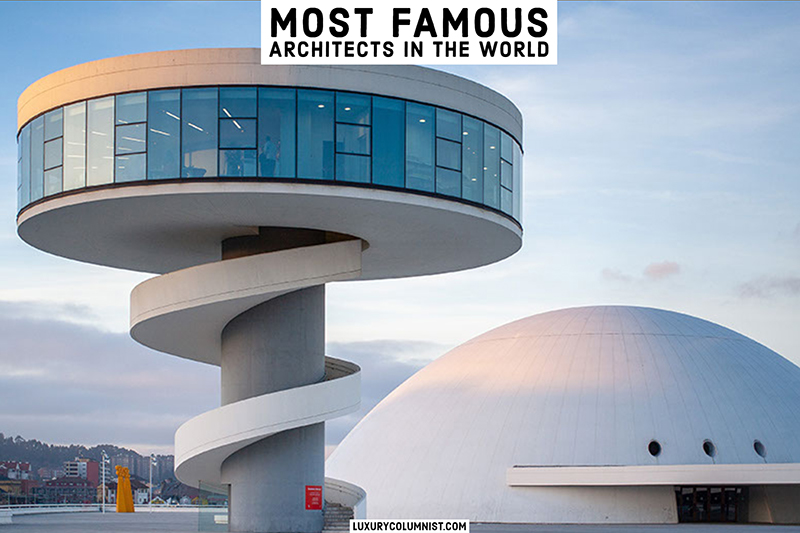
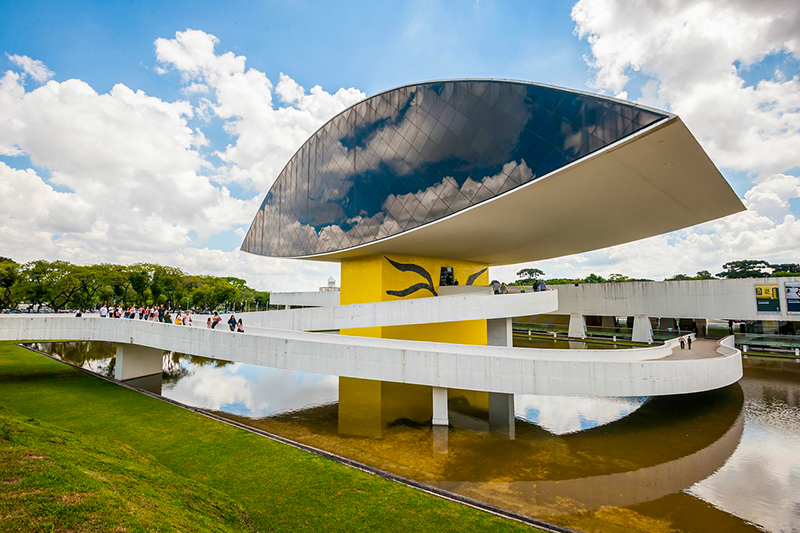
Oscar Niemeyer was one of the world’s most famous architects, renowned for his sweeping curves and modernist vision. Born in Brazil, he was the key architect behind the city of Brasilia, which became a UNESCO World Heritage Site.
His works span several continents – we’ve seen the Oscar Niemeyer Auditorium in Ravello, Italy, a stark white structure perched on the Amalfi Coast. Niemeyer once said: “It is not the right angle that attracts me, nor the straight line, hard and inflexible. What attracts me is the free and sensual curve.”
Most famous works:
- The Cathedral of Brasilia (Brasilia, Brazil) – A hyperboloid structure of 16 concrete columns resembling hands reaching towards the sky
- Church of St Francis of Assisi (Pampulha, Brazil) – A free-form interior space with a dome composed entirely of stained glass
- Casino da Madeira (Funchal, Madeira) – A striking entertainment complex on the island of Madeira
- Niteroi Contemporary Art Museum (Rio de Janeiro, Brazil) – A saucer-shaped building perched on a clifftop overlooking Guanabara Bay
15. Santiago Calatrava (b. 1951)
This Swiss-Spanish architect may often deliver his projects late, but they’re always unforgettable! From the Museu do Amanha in Rio de Janeiro to the City of Arts and Sciences in Valencia, his imaginative structures breathe new life into cultural institutions.
Trained as both an architect and a structural engineer, Calatrava is also celebrated for his sculptural bridge designs, which often evoke the forms of the human body or natural organisms.
Most famous works:
- City of Arts and Sciences (Valencia, Spain) – A vast cultural and entertainment complex featuring futuristic white structures
- The Oculus (New York City) – The World Trade Center Transportation Hub, resembling a bird being released from a child’s hands
- Milwaukee Art Museum (Milwaukee, USA) – Features the Burke Brise Soleil, a moveable sunscreen that opens and closes like wings
- Peace Bridge (Calgary, Canada) – A helical pedestrian bridge with a tubular steel structure

16. Rem Koolhaas (b. 1944)
Rem Koolhaas is a Dutch architect renowned for his innovative designs that merge technology with architecture. A former journalist and screenwriter, he brings a narrative quality to his buildings that sets them apart. He won the Pritzker Prize in 2000 and founded the influential architecture firm OMA (Office for Metropolitan Architecture).
Koolhaas once said: “Talk about beauty and you get boring answers, but talk about ugliness and things get interesting.”
Most famous works:
- Seattle Public Library (Seattle, USA) – A striking angular building with a diamond-shaped glass and steel facade
- CCTV Headquarters (Beijing, China) – A continuous loop of interconnected activities forming a gravity-defying Z-shape
- Casa da Musica (Porto, Portugal) – A faceted white concrete concert hall with remarkable acoustics
- Qatar National Library (Doha, Qatar) – An open-plan library resembling an unfolding book

17. Eero Saarinen (1910-1961)
Eero Saarinen was a Finnish-American architect famous for his sculptural approach to modernism. Unlike many of his contemporaries, Saarinen refused to adopt a single signature style, instead designing each project to suit its specific purpose and context. He also designed iconic furniture pieces including the Tulip Chair.
Tragically, Saarinen died at just 51 from a brain tumour, but his relatively short career produced some of the most recognizable structures in America.
Most famous works:
- TWA Flight Center (JFK Airport, New York) – A soaring bird-like terminal with sweeping concrete curves, now the TWA Hotel
- Gateway Arch (St Louis, Missouri) – A 630-foot stainless steel catenary arch and America’s tallest man-made monument
- Dulles International Airport (Virginia, USA) – A dramatically suspended roof structure near Washington DC
- MIT Chapel (Cambridge, Massachusetts) – A cylindrical brick chapel where light reflects off a moat into the interior

18. Jean Nouvel (b. 1945)
Jean Nouvel is a French architect known for his unparalleled creativity and ability to break away from traditional architectural norms. He won the Pritzker Prize in 2008, and each of his projects is designed to respond uniquely to its cultural and climatic context.
Nouvel’s style is characterized by innovative use of materials, dramatic lighting effects and bold techniques that reflect his expertise in contemporary design.
Most famous works:
- Institut du Monde Arabe (Paris, France) – A building whose south facade features mechanical apertures inspired by traditional Islamic mashrabiya screens
- Louvre Abu Dhabi (Abu Dhabi, UAE) – A floating dome of 7,850 aluminium stars creating a rain of light effect
- One Central Park (Sydney, Australia) – A pair of residential towers draped in living vertical gardens
- Torre Agbar (Barcelona, Spain) – A bullet-shaped tower clad in 4,500 multicoloured LED devices

19. Bjarke Ingels (b. 1974)
Bjarke Ingels is a Danish architect who has rapidly become one of the most influential designers of his generation. His firm, BIG (Bjarke Ingels Group), is known for playful, socially conscious designs that challenge conventional thinking.
Ingels describes his approach as “pragmatic utopian” – creating buildings that are ambitious yet practical, sustainable yet fun. In 2016, he was named one of TIME magazine’s 100 Most Influential People.
Most famous works:
- Mountain Dwellings (Copenhagen, Denmark) – A residential complex where each apartment has a rooftop garden and a view
- CopenHill / Amager Bakke (Copenhagen, Denmark) – A waste-to-energy plant with a ski slope, hiking trail and climbing wall on its roof
- VIA 57 West (New York City) – A tetrahedron-shaped residential building nicknamed the courtscraper
- LEGO House (Billund, Denmark) – An experience centre composed of 21 overlapping blocks resembling giant LEGO bricks

20. Richard Meier (b. 1934)
Richard Meier is an American architect celebrated for his pristine white buildings and masterful use of natural light. He won the Pritzker Prize in 1984 at the age of 49, making him one of the youngest recipients.
His work draws heavily from Le Corbusier and represents a purist strand of modernism. The Jubilee Church in Rome is visible in our guide to some of the most expensive buildings in the world.
Meier’s signature white exteriors serve as canvases for the interplay of light and shadow throughout the day.
Most famous works:
- Getty Center (Los Angeles, USA) – A hilltop campus of travertine and aluminium buildings housing one of the world’s great art collections
- Barcelona Museum of Contemporary Art / MACBA (Barcelona, Spain) – A luminous white building in the heart of the Raval neighborhood
- Jubilee Church (Rome, Italy) – Three curving concrete shells that evoke the sails of a ship
- Smith House (Darien, Connecticut) – An early masterpiece of white residential architecture overlooking Long Island Sound

21. Herzog & de Meuron
Jacques Herzog and Pierre de Meuron are Swiss architects who founded their practice in Basel in 1978. Winners of the Pritzker Prize in 2001, they are known for their innovative approach to materials and their ability to transform existing structures into something entirely new.
Their conversion of London’s Bankside Power Station into Tate Modern is one of the most successful adaptive reuse projects in architectural history – and one we visit regularly, being London residents.
Most famous works:
- Tate Modern (London, UK) – A former power station transformed into one of the world’s most visited contemporary art galleries
- Beijing National Stadium / Bird’s Nest (Beijing, China) – The iconic venue for the 2008 Olympics, with an interlocking steel lattice structure
- Elbphilharmonie (Hamburg, Germany) – A crystalline glass wave perched atop a former warehouse, housing a world-class concert hall
- M+ Museum (Hong Kong) – A striking inverted T-shaped building in the West Kowloon Cultural District

22. Shigeru Ban (b. 1957)
Shigeru Ban is a Japanese architect who won the Pritzker Prize in 2014, recognized for his humanitarian work and innovative use of unconventional materials – particularly cardboard tubes and paper. He has designed emergency shelters for disaster zones around the world, proving that great architecture can also serve those in greatest need.
Ban demonstrates that sustainability and beauty can coexist, using recyclable materials to create structures that are both elegant and responsible.
Most famous works:
- Centre Pompidou-Metz (Metz, France) – A flowing Chinese-hat-shaped roof of laminated timber, the largest temporary exhibition space in France
- Cardboard Cathedral (Christchurch, New Zealand) – A transitional cathedral built from cardboard tubes after the 2011 earthquake
- Mount Fuji World Heritage Centre (Shizuoka, Japan) – An inverted cone structure that reflects Mount Fuji in a shallow pool
- Paper Log Houses (Kobe, Japan and global) – Emergency shelters using beer crates for foundations and cardboard tubes for walls

23. Kengo Kuma (b. 1954)
Kengo Kuma is a Japanese architect known for his philosophy of making architecture that disappears into its environment. His use of natural materials – wood, bamboo, stone and paper – creates buildings that feel both modern and deeply connected to nature and Japanese design traditions.
Kuma’s approach represents a counterpoint to the monumental concrete and glass structures that dominated late 20th century architecture.
Most famous works:
- Japan National Stadium (Tokyo, Japan) – The main venue for the Tokyo 2020 Olympics, featuring a timber lattice design inspired by traditional Japanese architecture
- V&A Dundee (Dundee, Scotland) – Scotland’s first design museum, with a dramatic cliff-inspired facade of concrete panels
- Starbucks Reserve Roastery (Tokyo, Japan) – A four-storey flagship featuring a 17-metre copper cask and origami-inspired ceilings
- Great (Bamboo) Wall House (Beijing, China) – A residential project where bamboo walls blur the boundary between interior and exterior

24. Richard Rogers (1933-2021)
Richard Rogers was a British architect whose landmark projects helped define the high-tech architecture movement. He had a strong interest in urban regeneration, sustainability and social responsibility.
This “starchitect” was awarded the Pritzker Architecture Prize, the Royal Institute of British Architects’ Royal Gold Medal and the French Legion d’Honneur.
Most famous works:
- Centre Pompidou (Paris, France) – Co-designed with Renzo Piano, this radical inside-out building exposed its structural and mechanical systems on the exterior
- Lloyd’s of London (London, UK) – A striking stainless steel building in the City of London with external lifts and staircases
- Heathrow Airport Terminal Five (London, UK) – A light-filled terminal handling over 30 million passengers per year
- Millennium Dome / The O2 (London, UK) – Now one of the world’s busiest entertainment venues

25. Jeanne Gang (b. 1964)
Jeanne Gang is an acclaimed American architect whose designs explore the relationship between nature, the built environment and social context. Her firm, Studio Gang, has produced some of the most innovative buildings in Chicago and beyond.
She was named one of TIME’s 100 Most Influential People in 2019.
Most famous works:
- Aqua Tower (Chicago, USA) – An 87-storey residential skyscraper with an undulating concrete facade that creates unique balcony shapes on every floor
- Richard Gilder Center (New York City) – A seamless addition to the American Museum of Natural History with canyon-like interiors
- Solstice on the Park (Chicago, USA) – A residential tower with angled window bays designed to maximize winter sun and minimize summer heat
- Writers Theatre (Glencoe, Illinois) – An intimate theatre complex wrapped in a wooden lattice screen

26. Philip Johnson (1906-2005)
Philip Johnson was an American architect best known for his Glass House, a transparent residential masterpiece. He was the first recipient of the Pritzker Architecture Prize in 1979.
Johnson’s career spanned multiple architectural movements, from the International Style to Postmodernism.
Most famous works:
- Glass House (New Canaan, Connecticut) – A fully transparent steel and glass residence where Johnson himself lived, now open to the public
- AT&T Building / 550 Madison Avenue (New York City) – A postmodern skyscraper with a distinctive Chippendale pediment top
- Crystal Cathedral (Garden Grove, California) – A star-shaped glass church designed with over 10,000 rectangular panes

27. Louis Sullivan (1856-1924)
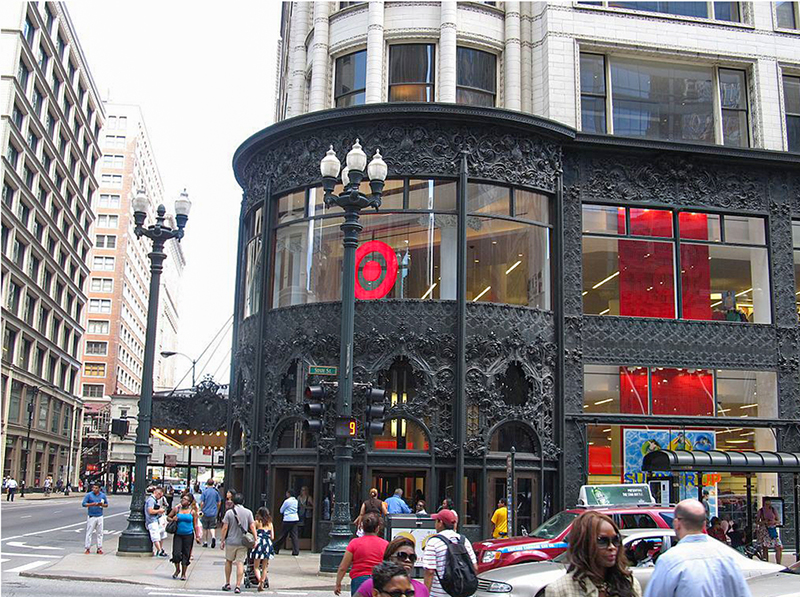
Often considered the “father of modernist architecture” and the “father of the skyscraper”, Louis Sullivan was one of the most influential figures in the Chicago School of Architecture. Born in Boston, Sullivan pioneered the aesthetic of the tall commercial building, coining the phrase “form follows function” – perhaps the most famous maxim in architecture.
Most famous works:
- Wainwright Building (St Louis, Missouri) – Considered the first true skyscraper in terms of vertical aesthetic expression
- The Sullivan Building / Carson, Pirie, Scott and Company Building (Chicago, Illinois) – Features intricate cast-iron decoration inspired by local plant forms
- Bayard-Condict Building (New York City) – The only Sullivan-designed building in New York, with ornate terracotta detailing
- Guaranty Building (Buffalo, New York) – A masterwork of ornamental terracotta covering a steel-framed structure
28. Buckminster Fuller (1895-1983)
An innovative champion of the geodesic dome, Buckminster Fuller was an inventor, architect and futurist who held US patents for his dome designs. His work was driven by a deep commitment to sustainability and finding ways to do more with less – a concept he called “ephemeralization”.
Most famous works:
- Montreal Biosphere (Montreal, Canada) – Originally the US pavilion at Expo 67, this geodesic dome is now an environmental museum
- Geodesic Domes (various locations worldwide) – His patented designs have been used in over 300,000 structures globally
- Dymaxion House (Henry Ford Museum, Michigan) – A prototype for mass-produced, energy-efficient housing

29. Wolf D. Prix (b. 1942)
Austrian architect Wolf D. Prix and his studio Coop Himmelb(l)au are famous for their ground-breaking deconstructivist designs. This practice sees buildings as functional artworks that are open to their surroundings, creating dynamic spaces that encourage interaction.
Most famous works:
- BMW Welt (Munich, Germany) – A futuristic delivery and experience centre for BMW customers with a dramatic double-cone structure
- Musee des Confluences (Lyon, France) – A cloud-like crystalline structure at the confluence of the Rhone and Saone rivers
- Dalian International Conference Center (Dalian, China) – A vast conference centre with an amorphous, flowing exterior
- House of Music (Aalborg, Denmark) – An open structure encouraging exchanges between students, teachers, audiences and artists

30. William Pereira (1909-1985)
This American architect from Chicago was known for his futuristic designs. Before becoming an architect, Pereira was a Hollywood set designer who won an Oscar for his work on Reap the Wild Wind, a Cecil B. DeMille movie.
After serving as an Army civilian camouflage expert during World War II, he taught architecture at the University of California before setting up his own practice. Several famous architects did stints at his firm, including Gin D. Wong and Frank Gehry.
Most famous works:
- The Transamerica Pyramid (San Francisco, California) – An iconic tapered skyscraper that defined the San Francisco skyline for decades
- Geisel Library (UC San Diego, California) – A brutalist masterpiece that appears to float on concrete pillars, named after Dr Seuss
- Theme Building at LAX (Los Angeles, California) – A space-age structure resembling a flying saucer at Los Angeles International Airport
- University of California Irvine Campus – A master plan for a futuristic campus integrated with the environment

Frequently Asked Questions About Famous Architects
Who is considered the greatest architect of all time?
While opinions vary, Frank Lloyd Wright is frequently cited as the greatest architect of all time due to his prolific output, innovative organic design philosophy and lasting influence on residential and commercial architecture. Other strong contenders include Le Corbusier, Andrea Palladio and Antoni Gaudi.
Who was the first woman to win the Pritzker Architecture Prize?
Zaha Hadid became the first woman to win the Pritzker Architecture Prize in 2004. Known as the Queen of the Curve, her futuristic designs broke new ground in parametric architecture and continue to inspire architects around the world.
What is the Pritzker Architecture Prize?
The Pritzker Architecture Prize is widely considered the highest honor in architecture, often described as the Nobel Prize of architecture. Established in 1979 by the Pritzker family of Chicago, it recognizes architects whose built work demonstrates a combination of talent, vision and commitment.
Past winners include Frank Gehry, Renzo Piano, Zaha Hadid, Norman Foster and Tadao Ando.
Which famous architect designed the most buildings?
Frank Lloyd Wright designed over 1,000 structures during his career, of which more than 500 were completed. This makes him one of the most prolific architects in history, with works ranging from private homes to museums, churches and office buildings.
What architectural style is most popular today?
Contemporary architecture today embraces sustainability, biophilic design and adaptive reuse. Architects like Bjarke Ingels, Kengo Kuma and Shigeru Ban are leading the way with designs that prioritize environmental responsibility alongside aesthetic innovation.
The recent trend towards authenticity in all creative fields has also renewed interest in vernacular and locally rooted architectural traditions.
Final Thoughts on the Most Famous Architects in the World
We hope you enjoyed this guide to the most famous architects in the world and their iconic buildings. These visionaries have each left an indelible mark on history, and their works are well worth seeking out in person.
Whether you’re admiring Gaudi’s mosaics in Barcelona, crossing Norman Foster’s Millennium Bridge in London or standing beneath the soaring dome of St Paul’s Cathedral – as we do regularly near our London home – architecture has the power to move and inspire like few other art forms.
For more cultural inspiration, explore our guides to the most famous painters in the world and the most famous sculptures. Design enthusiasts may also enjoy our features on famous Italian design classics and famous Italian furniture designers.
Like this guide to world famous architects? Pin for later or share with friends.


Thanks, we’ve corrected it.
William Pereira! Transamerica building, LAX, city of Irvine!
1.Philip Johnson (AT&T)
2.Buckminster Fuller (Geodesic Dome pioneer)
3.Michael Graves (Post modernist)
Many thanks for the suggestions, we’ve heard that Philip Johnson is a rather controversial figure but we might include him anyway with a caveat, and we’ll look at including the others – Buckminster Fuller’s designs are amazing!
Paul R. Williams Architect
member of AIA
architect to the stars of Hollywood and Beverly Hills CA in the 1930’s, 40’s, and 50’s …. notable design on LA airport !
Wolf d Prix Coop Himmelblau
BMW Weld Munich
Musee du Confluence Lyon
Asiatic Film centre Busan
European Central Bank
MOCAPE China