What Is the Most Famous Impressionist Painting?
The most famous Impressionist painting is Claude Monet’s Water-Lily Pond, the best-known work from his series of around 250 water lily canvases painted at his garden in Giverny, Normandy. Close behind it is Impression, Soleil Levant (1872), the Monet harbor scene that gave the entire movement its name. Both hang in Paris: the Water-Lily Pond at the National Gallery in London, and Impression, Soleil Levant at the Musée Marmottan Monet.
Impressionism changed the way that artists paint and paved the way for contemporary art. Here are the most famous Impressionist paintings that revolutionized the art world.
Overview of Famous Impressionist Paintings
So what exactly is Impressionism? This radical art movement started in the 19th century in France.
Artists rejected traditional painting methods that used precise brush strokes and stylized portraiture. Instead, they took their easels outdoors (en plein air in French)and depicted the changing light and colors. Many Impressionist painters were inspired by Asian artists, who focused on the subject matter rather than complex backgrounds.
Impressionist art is all about capturing the moment and breaking away from imposed norms. In Paris, a state-sponsored exhibition known as The Salon decided whose paintings could be shown.
A group of artists called the Anonymous Society of Painters, Sculptors, & Printmakers, etc. organized an independent exhibition in 1874. They were annoyed that their paintings had all been turned down by the official Paris Salon and the Academy of Fine Arts.
The founding members of the Impressionist movement included Claude Monet, Alfred Sisley, Camille Pissarro and Edgar Degas. Their first collective exhibition at a gallery on Rue du Capucines in Paris brought together 165 artworks and 30 artists. The art world would never be the same again!
These famous paintings look at their subject matter in a new way and prompt us to do the same.
What Makes a Painting Impressionist?
Impressionism is defined by a handful of instantly recognizable techniques. Understanding them makes every painting on this list easier to read and appreciate.
●Loose, visible brushstrokes: paint is applied quickly, often leaving the marks of individual strokes rather than blending them smooth.
●Natural, outdoor light: painters worked en plein air, chasing the way sunlight changes by the hour.
●Everyday subject matter: cafes, dance halls, riverbanks and domestic interiors replaced mythology and history as worthy subjects.
●Pure, unblended color: shadows are blue and purple, not black; the eye mixes the colors rather than the brush.
●Snapshot composition: figures are cropped at the canvas edge, giving the feel of a candid photograph rather than a posed portrait.
These five qualities appear, in some combination, in every famous Impressionist painting on this list.
The Key Impressionist Artists
The founding members of the Impressionist movement were a tight circle who exhibited together and shaped each other’s work.
●Claude Monet: the movement’s defining voice; his series paintings of haystacks, cathedrals and water lilies established the idea of capturing light at a specific moment in time.
●Pierre-Auguste Renoir: celebrated for warm, light-filled scenes of leisure and the human figure; Renoir represented the joyful side of Impressionism.
●Edgar Degas: a realist at heart who used the Impressionist group as a platform; his ballet and café scenes are among the most recognized works of the era.
●Camille Pissarro: the group’s most committed plein-air painter and a mentor to Cézanne and Gauguin.
●Alfred Sisley: an English painter working in France, devoted almost entirely to landscape.
●Berthe Morisot: one of the movement’s founding exhibitors and among the most significant female Impressionist artists; her domestic interiors and portraits of women remain widely studied.
●Mary Cassatt: the only American to exhibit with the Impressionists, known for intimate scenes of women and children.
●Édouard Manet: the movement’s reluctant godfather; his controversial subjects inspired the group even as he preferred the traditional Salon.
14. The Starry Night – Vincent Van Gogh
While Vincent van Gogh is considered to be a Post-Impressionist painter, his work, Starry Night, is an influential piece of art that has inspired many Impressionist artists. The painting is an oil depiction of a village landscape at night, as van Gogh saw it outside of his window in the asylum room where he stayed.
The painting’s bright colors and swirling composition embody Impressionist style and paved the way for future artists. Some people believe that it symbolizes hope.

13. Luncheon of the Boating Party – Auguste Renoir
Auguste Renoir’s Luncheon of the Boating Party is a masterpiece that represents the carefree leisure of the upper-class society in 19th century France. The painting depicts a group of people enjoying a day out in a boating party.
The use of light, color, and texture creates a lively and friendly atmosphere that makes the painting come to life. Renoir’s Luncheon of the Boating Party (Le déjeuner des canotiers in French) is one of the most celebrated Impressionist paintings of all time.
This famous Impressionist artwork is on display at The Phillips Collection in Washington D.C.

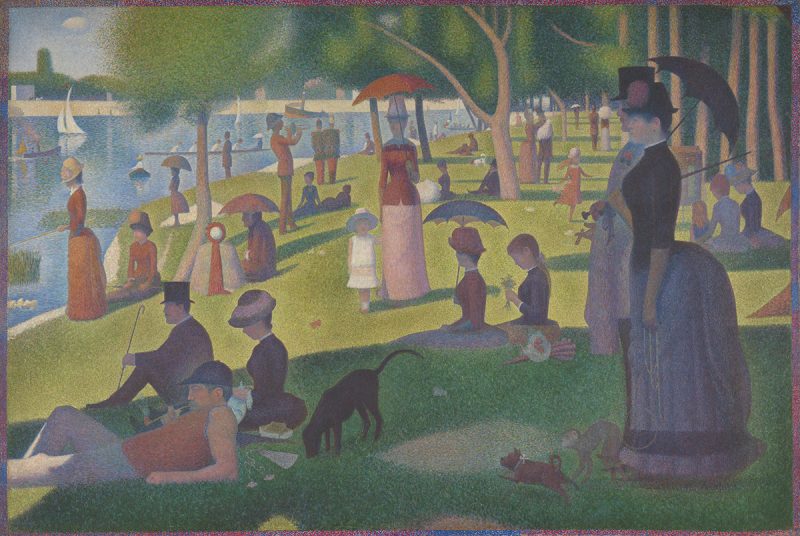
12. A Sunday Afternoon on the Island of La Grande Jatte – Georges Seurat
Georges Seurat was a renowned French painter, and his most famous work is “A Sunday Afternoon on the Island of La Grande Jatte.” The painting depicts a scene of people enjoying their leisure time on an island in Paris.
It is famous for the artist’s usage of pointillism, which involves painting small dots of colors that our eyes blend together. Seurat founded the Neo-Impressionism movement, characterized by vibrant color and its precise application of paint to the canvas.
The painting is on display at the Art Institute of Chicago, and it has become one of the top attractions in the museum.
11. The Dance Class – Edgar Degas
Edgar Degas is known for his pastel paintings of ballerinas, whom he painted throughout his career. They were often depicted behind the scenes rather than on stage, which was in keeping with his interest in everyday life.
Degas preferred to be known as a realist, and he generally painted indoors in a dance class. Having said that, he was a leader in the Impressionist group, helping to organize their independent exhibitions.
One of Degas’ most celebrated works, “The Dance Class” (also known as “The Ballet Class”) captures ballet dancers during a rehearsal under the supervision of ballet master Jules Perrot. The diagonal line of dancers creates depth, while the mirrors on the wall add complexity by reflecting parts of the room outside our direct view.
This work exists in multiple versions, with the most famous housed at the Metropolitan Museum of Art in New York. Another version is at the Musée d’Orsay in Paris.

10. Girl Arranging Her Hair – Mary Cassatt
The only American painter to exhibit with the Impressionists, Mary Cassatt was highly skilled in portraying women and children in intimate settings. She lived in France for much of her life and became close friends with Degas.
Along with Berthe Morisot, the French painter, she was one of the most famous female Impressionist artists.
Cassatt was a professionally trained artist, highly skilled in using pastels to convey the impression of natural light. She enjoyed experimenting with new techniques and would often leave parts of her canvas unfinished to express spontaneity.
In Girl Arranging Her Hair, one of Cassatt’s most famous works, we observe a private moment of introspection. The subtle contrast of pink wallpaper and flushed cheeks with the sitter’s blue toned nightdress and water jug is skillfully executed.
Although Degas once said to Cassatt, “What do women know about style?”, he traded this painting for one of his own and it hung in pride of place in his private salon. It is now exhibited at The National Gallery of Art in Washington D.C.

9. Impression, Soleil Levant – Claude Monet
The famous artwork from which Impressionism takes its name is by Claude Monet. The critic Louis Leroy unfavorably called it a mere sketch or “impression,” rather than a finished painting. Monet became one of the most iconic painters of all time.
Using short, loose brushstrokes and unblended colors, Monet emphasizes the reflection of the water and the thick fog. Completed in 1872, the painting depicts sunrise at the harbour in Le Havre, France.
Most likely completed in a single sitting, this famous Impressionist painting may well have been inspired by the work of J.M.W. Turner. Monet had recently seen the artist’s works in London and been struck by the pervasive fog.
This painting is on display at the Musee Marmottan-Monet in Paris. You can create your own version with an Impression Sunrise Painting by Numbers Kit. It requires no artistic ability and makes a great gift.

8. Paris Street; Rainy Day – Gustave Caillebotte
This unusual painting successfully portrays a rainy day, even though we don’t see actual rainfall. The umbrellas and shining cobblestones convey humidity, while the painter observes his subjects with a detached air.
Caillebotte often painted members of the working class, as in another of his well known artworks, The Floor Scrapers. In this oil painting he also depicts a couple of flaneurs, or members of the bourgeoisie out for a stroll.
He came from a wealthy family and was a patron of other Impressionists. What is striking about this painting is the aspect of photo realism.
Caillebotte’s brother Martial was a keen photographer and there are several elements of photography at play here. The man to the far right of the painting is cropped out, in a similar fashion to a photograph and the man and woman in the foreground appear more prominent than the figures in the background.
You can admire this innovative artwork at the Art Institute of Chicago.

7. L’Absinthe – Edgar Degas
The Absinthe Drinker is one of the most famous Impressionist paintings. Originally called Dans Un Cafe (In a Cafe), this intimate oil painting shows a couple who appear somewhat the worse for wear.
It looks like they’ve overdone the absinthe on the table! Finished in 1876, this artwork depicts two friends of Degas.
Ellen Andrée was an actress who also featured in several of Manet’s paintings, while Marcellin Desboutin was a painter. In this painting, Degas cuts off the man’s pipe, giving the impression of a casual snapshot. You can view it in the Musee d’Orsay, Paris.

6. Bal du Moulin de la Galette – Pierre-Auguste Renoir
Known in English as Dance at Le Moulin de la Galette, this 1876 painting by Renoir can also be seen at the Musée d’Orsay. Evoking a carefree atmosphere, it depicts working class people enjoying their Sunday afternoon.
The artist has masterfully captured the flickering light and sense of vitality. While some of the people shown were Renoir’s friends, others were professional models.
The outdoor dance hall, Le Moulin de la Galette in Montmartre was close to Renoir’s home and somewhere that he went quite often. Several neo-Impressionists subsequently immortalized this site in their art, including Henri de Toulouse-Lautrec and Vincent van Gogh.
Create your own version of another famous Renoir artwork with a Luncheon of the Boating Party paint by numbers kit! It’s easy to do and includes free shipping worldwide.

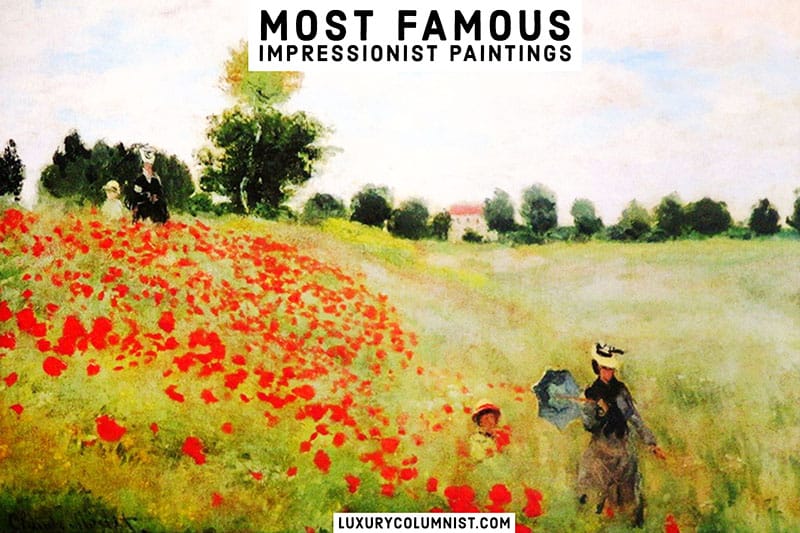
5. Poppy Field – Claude Monet
Created in 1873, this landscape painting by Monet features a mother and child walking through a field of poppies. They were most likely the artist’s wife Camille and son Jean.
The field is thought to be in Argenteuil, France, where Monet lived from 1871 to 1878. He managed to capture the movement of the poppies in this atmospheric artwork.

4. The Boulevard Montmartre at Night – Camille Pissarro
One of the four main boulevards or avenues in Paris, The Boulevard Montmartre is lined with fashionable apartment blocks created when Baron Haussmann redesigned Paris city center.
Camille Pissarro painted this street in the morning as well as at night, from his room at the Grand Hôtel de Russie. The diagonal lines of the pavements and rooftops create an effect of depth.
Notice the reflected light on the rain-soaked pavement on the right which is beautifully depicted. The Boulevard Montmartre at Night is part of The National Gallery collection in London.

3. A Bar at the Folies-Bergere – Edouard Manet
Although Manet was regarded by the Impressionists as their inspiration, he was something of a reluctant Impressionist. From a wealthy background, Manet preferred to exhibit at the traditional Salon rather than the independent Impressionist exhibitions.
However, his daring and controversial works such as Dejeuner sur l’herbe and Olympia were certainly trailblazing. Manet was adept in depicting everyday scenes of ordinary people such as this barmaid in the Folies-Bergere nightclub.
Manet’s last major painting, accomplished when he was already ill with syphilis, shows us two sides of a woman’s experience. In the mirror’s reflection, she leans attentively towards a customer, however face-on she looks dejected and pensive.
Look to her left and you’ll spot a woman at the bar peering through opera glasses, which further enhances the painting’s observational elements. To the top left, you can spot the green shoes of a trapeze artist performing at the club.
This fascinating Impressionist painting can be seen at The Courtauld Gallery, London.

2. Dance at Bougival – Pierre-Auguste Renoir
Another masterpiece by Renoir, Dance at Bougival is a highlight of the Museum of Fine Arts in Boston, Massachusetts. Parisians flocked to the outdoor dancing terraces in the suburbs of the city.
This oil painting was commissioned by the collector Paul Durand-Ruel, as part of a series of three with a common theme of dancing. The dancing lady’s flushed face and the couple’s close proximity gives a sense of intimacy.
Renoir was the son of a tailor and a dressmaker, and skilled at capturing details like the woman’s fitted dress and red bonnet.

1. The Water-Lily Pond – Claude Monet
Arguably the most famous Impressionist paintings of all are the series of water lily artworks, or Nymphéas in French, created by Claude Monet. There are around 250 oil paintings of Monet’s flower garden in Giverny, Normandy.
The artist created a Japanese inspired garden with a curved bridge, adding weeping willow trees and water lilies. He spent much of the last 30 years of his life painting this scene in different lights.
Rather than depicting the edge of the banks or the sky, the focus is brought in to the surface of the water. Many of the water-lily paintings are displayed at the Musée Marmottan Monet in Paris, although this one is in The National Gallery, London.
Recreate the iconic scene yourself with a painting by numbers Bridge Over a Pond of Water-Lilies kit!

Although famous artists like Vincent Van Gogh, Georges Seurat, Paul Cézanne and Paul Gauguin are sometimes referred to as Impressionists, they’re actually part of the Post-Impressionist movement which focused on formal structure.
Key Takeaways
●Monet’s Water-Lily Pond: the most famous Impressionist painting.
●Impression, Soleil Levant (1872) gave the movement its name.
●First Impressionist show: 165 works, 30 artists, Paris, 1874.
●Musée d’Orsay and the National Gallery hold the most key works.
●Seurat, Van Gogh and Cezanne are Post-Impressionist, not Impressionist.
●Mary Cassatt: the only American to exhibit with the Impressionists.
●Loose brushwork, outdoor light and snapshot composition define the style.
In Conclusion: Most Famous Impressionist Paintings
The Impressionists brought us some of the most beloved paintings in history. These artists challenged the status quo and paved the way for new styles of art. If you’re interested in learning more about famous paintings, be sure to check out our other art features.
Frequently Asked Questions
Who are the most famous Impressionist artists?
The most famous Impressionist artists include Claude Monet, Pierre-Auguste Renoir, Edgar Degas, Camille Pissarro, Alfred Sisley, Berthe Morisot, Mary Cassatt and Edouard Manet. The founding group first exhibited together in 1874 at a gallery on the Rue du Capucines in Paris, bringing together 165 artworks and 30 artists.
Where can I see famous Impressionist paintings in person?
Famous Impressionist paintings are spread across several great museums. The Musée d’Orsay in Paris holds L’Absinthe and Bal du Moulin de la Galette. The National Gallery in London has The Water-Lily Pond and The Boulevard Montmartre at Night.
The Courtauld Gallery in London displays A Bar at the Folies-Bergere. In the United States, the Art Institute of Chicago holds Paris Street; Rainy Day, the Metropolitan Museum of Art in New York holds The Dance Class, and the Museum of Fine Arts in Boston holds Dance at Bougival.
What is the difference between Impressionism and Post-Impressionism?
Impressionism focused on capturing fleeting light and everyday moments with loose, spontaneous brushwork. Post-Impressionism, associated with artists like Vincent van Gogh, Georges Seurat, Paul Cezanne and Paul Gauguin, built on that foundation but placed greater emphasis on formal structure, symbolic content and personal expression.
Seurat’s pointillist technique and Van Gogh’s swirling, emotionally charged lines are both Post-Impressionist responses to the Impressionist method.
You may also enjoy:
- Best Virtual Art Museum Tours
- Most Beautiful Sculpture Parks In The World
- Real Places That Inspired the Impressionist Artists
- Top American Paintings to Know
- Watches That Retain Their Value
Like these famous Impressionist paintings? Pin for later or share with friends.