
The architecture world mourns the loss of Frank Gehry, who passed away on December 5, 2025, at age 96. The Canadian-American architect transformed contemporary design with his sculptural, gravity-defying structures that turned buildings into works of art.
From the sun-soaked curves of Bilbao to the gleaming titanium of Los Angeles, Gehry’s buildings didn’t just house functions – they sparked joy, controversy, and wonder. Here are his most remarkable creations.
1. Guggenheim Museum Bilbao, Spain (1997)
The building that changed everything. When Gehry’s Guggenheim opened in the Basque city of Bilbao, it wasn’t just a museum – it was an economic phenomenon.
The billowing titanium structure, resembling a ship or a fish depending on your perspective, drew visitors from around the world and injected an estimated $500 million annually into the local economy. The late Philip Johnson, godfather of American modern architecture, stood in its atrium and wept, calling it “the greatest building of our time.”
The “Bilbao Effect” – the transformation of a city through iconic architecture – was born here, and architects have been chasing it ever since.

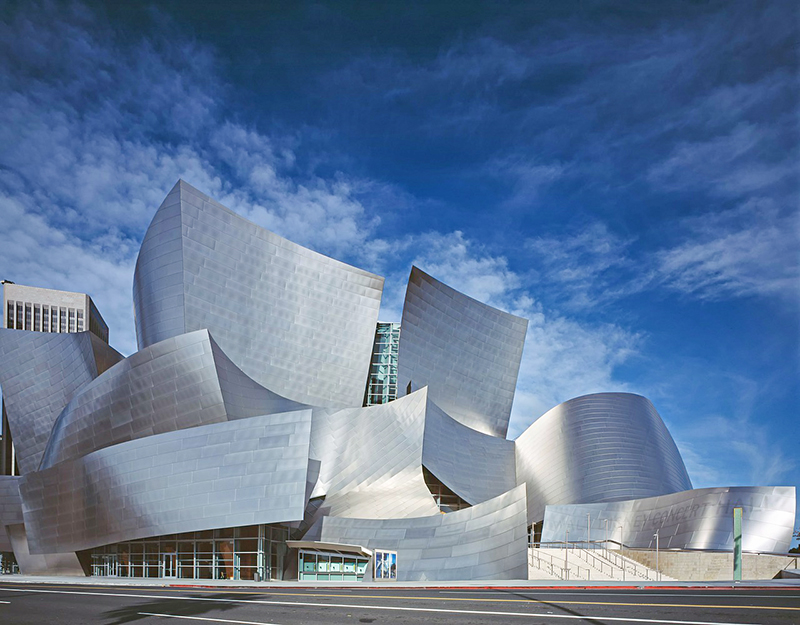
2. Walt Disney Concert Hall, Los Angeles (2003)
Gehry’s love letter to his adopted hometown, the Disney Concert Hall rises from downtown Los Angeles like frozen music. Its stainless steel exterior catches the California sun in ways that shift throughout the day, while inside, the Douglas fir-clad auditorium is renowned for its exceptional acoustics.
Critics who once mocked it as “broken crockery” were silenced when the building became the centerpiece of LA’s cultural renaissance. This is Gehry at his most confident – swooping, soaring, and unapologetically optimistic.
3. Fondation Louis Vuitton, Paris (2014)
In the Bois de Boulogne, Gehry created what appears to be a crystalline ship with billowing glass sails. Bernard Arnault, LVMH’s chairman who commissioned the building, called Gehry “a genius of lightness, transparency, and grace” – qualities on full display here.
The twelve glass panels seem to float impossibly above the building’s white concrete galleries, creating a structure that changes with every shift of light. It’s Gehry’s most ethereal work, proving he hadn’t lost his revolutionary edge even in his 80s.

4. Gehry Residence, Santa Monica (1978)
Where it all began. Gehry bought a modest 1920s bungalow in Santa Monica for $50,000 and wrapped it in corrugated metal, chain-link fencing, and plywood. Neighbors were horrified. Architecture critics were mesmerized.
By exposing the bones of the original house while encasing it in industrial materials, Gehry announced a new architectural language – one that embraced the unfinished, the unconventional, and the deliberately raw. The exterior of the house remains a pilgrimage site for architecture students worldwide.

5. Dancing House, Prague (1996)
Affectionately nicknamed “Fred and Ginger” by locals, this whimsical pair of towers appears to dance along the Vltava River. One building leans into the other in a concrete embrace, their curves and angles creating movement in static form.
In a city dominated by Baroque and Gothic architecture, Gehry’s postmodern intervention was controversial, but it has become one of Prague’s most photographed landmarks – proof that playfulness has a place even in the most historic of settings.

6. Art Gallery of Ontario, Toronto (2008)
Gehry returned to his birthplace to transform the AGO with a stunning facade of glass and Douglas fir that curves like a wave along Dundas Street. The renovation didn’t obliterate the original building but rather embraced it, adding dramatic skylights and a spectacular curved staircase that feels simultaneously sculptural and functional.
For Toronto, it was a homecoming – Gehry bringing his mature vision back to the city where he first dreamed in wood scraps on his grandmother’s floor.

7. Vitra Design Museum, Weil am Rhein, Germany (1989)
Gehry’s first building in Europe, the Vitra Design Museum looks like a collection of white geometric forms – cubes, curves, and angles – that somehow cohere into a unified whole. It’s smaller and quieter than his later showpieces, but it contains the DNA of everything that would follow.
The building doesn’t sit on the landscape; it erupts from it, dynamic and uncompromising.

8. Biomuseo, Panama City, Panama (2014)
Gehry’s only building in Latin America explodes with color – reds, yellows, blues – like a tropical bird taking flight over Panama’s Amador Causeway. Commissioned to tell the story of Panama’s biodiversity, the museum’s bright metal canopies create covered outdoor spaces perfect for the tropical climate.
It’s Gehry freed from the constraints of institutional neutrality, embracing exuberance with open arms.

9. Marqués de Riscal Hotel, Elciego, Spain (2006)
In the heart of Spain’s Rioja wine region, Gehry wrapped a luxury hotel in ribbons of pink, gold, and silver titanium. The structure rises from the vineyards like a crushed gift box, its twisted forms catching light and casting dramatic shadows on the surrounding landscape.
Frank Lloyd Wright once said a building should “grow out of the land” – Gehry’s version seems to grow out of the land, then immediately rebel against gravity.

10. Experience Music Project, Seattle (2000)
Now known as the Museum of Pop Culture, this riot of color and curved metal was designed to evoke a smashed guitar. Purple, red, silver, and gold panels wrap around the structure in what Gehry described as “frozen music.”
Critics were divided – some called it a masterpiece of contemporary design, others “something the cat dragged in” – but no one could ignore it. That was always Gehry’s gift: making buildings impossible to ignore.

The Legacy of Frank Gehry
Frank Gehry spent nearly eight decades proving that buildings didn’t have to be boxes, that titanium could dance, and that architecture at its best could make people feel something. He won the Pritzker Prize, the Presidential Medal of Freedom, and virtually every other honor his profession could bestow.
But perhaps his greatest achievement was this: he made millions of people who’d never thought about architecture stop and stare, smile, argue, and dream.
“I’ve always been for optimism,” Gehry once said, “and architecture not being sad.” In a career spanning from chain-link fences to titanium clouds, he never wavered from that belief. The buildings remain – swooping, gleaming, utterly alive.
Read next:
