
Tracing the finely crafted structures with your eyes, almost feeling the cool embrace of the marble on your fingertips – nothing screams the art of finesse quite like sculptures. These artful architects create structures that embody countless hours trapped within the confines of art pieces, leaving traces of its brilliance for generations to enjoy.
Ready to dive into the most significant sculptures in history? We’ll take you through a journey of the various famous sculptures of the world and how they came to be.

What Are The Most Famous Sculptures in the World?
From ancient Greece to modern-day Chicago, these man-made art structures find their roots in various walks of life. Listed below are some of the most iconic cut, cast and chiselled sculptures to fall in love with.
19. Christ the Redeemer (Paul Landowski and Heitor da Silva Costa)
This colossal Art Deco statue of Jesus Christ stands 98 feet tall with arms outstretched spanning 92 feet wide, creating one of the most recognizable silhouettes in sculptural history. Located atop the 2,300-foot Corcovado mountain overlooking Rio de Janeiro, Brazil, Christ the Redeemer has become both a cultural icon and a significant religious symbol.
Constructed between 1922 and 1931, the monument was designed by Brazilian engineer Heitor da Silva Costa, with French-Polish sculptor Paul Landowski creating the sculptural elements. The statue is made of reinforced concrete and covered with approximately six million soapstone tiles. Its simplistic, geometric form exemplifies the Art Deco style popular during that period.
Designated as one of the New Seven Wonders of the World in 2007, Christ the Redeemer attracts nearly two million visitors annually. The statue has survived lightning strikes, extreme weather, and the test of time to become not just a symbol of Christianity but also of Brazil itself.

18. Pietà (Michelangelo)
Michelangelo’s Pietà is a masterpiece of Renaissance sculpture that deserves recognition among the world’s most famous works of art. Created between 1498-1499 when Michelangelo was just 24 years old, this stunning marble sculpture depicts the body of Jesus Christ on the lap of his mother Mary after the Crucifixion.
The Pietà showcases Michelangelo’s unparalleled skill in rendering human anatomy and emotion in stone. The smooth, polished marble creates a sense of ethereal beauty, while the detailed folds of Mary’s robes demonstrate extraordinary technical virtuosity. It’s notable for its pyramidal composition and the youthful appearance of Mary, a deliberate artistic choice that sparked controversy in its time.
Located in St. Peter’s Basilica in Vatican City, the Pietà is the only work Michelangelo ever signed. After overhearing visitors attribute it to another sculptor, he carved his name across Mary’s chest – an act he later regretted. This iconic sculpture survived a hammer attack in 1972 and is now protected behind bulletproof glass.

17. Bust of Nefertiti (Unknown)
The Bust of Nefertiti is an ancient Egyptian sculpture and one of the most famous works of ancient art. It was created around 1345 BCE during the Amarna period. This was when the pharaoh Akhenaten and his wife Nefertiti ruled ancient Egypt.
The bust is made of limestone covered in painted stucco and depicts the head and upper torso of Nefertiti, the Great Royal Wife of Akhenaten. It was discovered in 1912 by the German archaeologist Ludwig Borchardt during excavations of the city of Amarna, Akhenaten’s capital. The bust is about 20 inches tall and weighs around 20 pounds. It is remarkably well-preserved.
Nefertiti is depicted wearing the distinctive crown known as the “crown of Upper Egypt”, with its characteristic form of the two tall feathers. The bust is housed in the Neues Museum in Berlin, Germany, where it remains one of the museum’s most prized and visited artifacts.

16. Apollo and Daphne (Gian Lorenzo Bernini)
Gian Lorenzo Bernini’s sculpture “Apollo and Daphne” is a Baroque masterpiece created between 1622-1625. It depicts the story from Ovid’s “Metamorphoses” where the god Apollo pursues the nymph Daphne.
She prays to her father, the river god Peneus, to transform her into a laurel tree to escape Apollo. The sculpture shows the moment of Daphne’s transformation, with her feet and legs turning into tree roots and her torso and arms becoming the branches and leaves of the laurel tree.
Apollo is shown reaching out to embrace Daphne with anguish as he realizes he is too late to stop her transformation. Bernini’s technical virtuosity is on full display, with the flowing drapery, the delicate facial features, and the incredible sense of movement and emotion captured.
The white marble piece is considered one of the greatest examples of the Baroque style, with its dramatic, energetic composition. This iconic sculpture is located in the Galleria Borghese in Rome, where it remains one of Bernini’s most famous and admired works.

15. Venus of Willendorf (Unknown)
Also known as the Nude Woman, this figurine is estimated to date back between 28 000- 25 000 BCE. The 11.1 centimetre high sculpture was found in Willendorf, Austria in 1908.
While most of its origin and purpose is cloaked in mystery, the statue is constructed out of oolitic limestone and depicts a faceless female form. This unique sculpture can be viewed at the Natural History Museum in Vienna, Austria.

14. Unique Forms of Continuity in Space (Umberto Boccioni)
Moving towards a more contemporary art style, this Italian Futurist-style sculpture was created in 1913. The bronze artwork embodies a striding figure and captures the Italian industrialization movement with the immersion of art and motion.
See casts of this modern sculpture at MoMa and The Met Museum in New York, as well as Museo de Arte Contemporáneo de la Universidad de São Paulo in Brazil.

13. The Little Mermaid (Edvard Eriksen)
A fair girl cast in bronze, lovingly gazing at the sea on a rock – The Little Mermaid statue is an enchanting spectacle. Inspired by the Hans Christian Anderson fairytale, this sculpture has been one of the prized sculptures of Copenhagen, Denmark since 1913.
A gift from Carl Jacobsen of Carlsberg Breweries to the city of Copenhagen, this four feet tall statue can be found on the Langelinie promenade. The Little Mermaid sculpture is actually a copy of the original statue, which is kept in an undisclosed location by its owners.
In addition, there are actually 14 copies of the Little Mermaid around the world, including in Brazil, Romania and the USA.

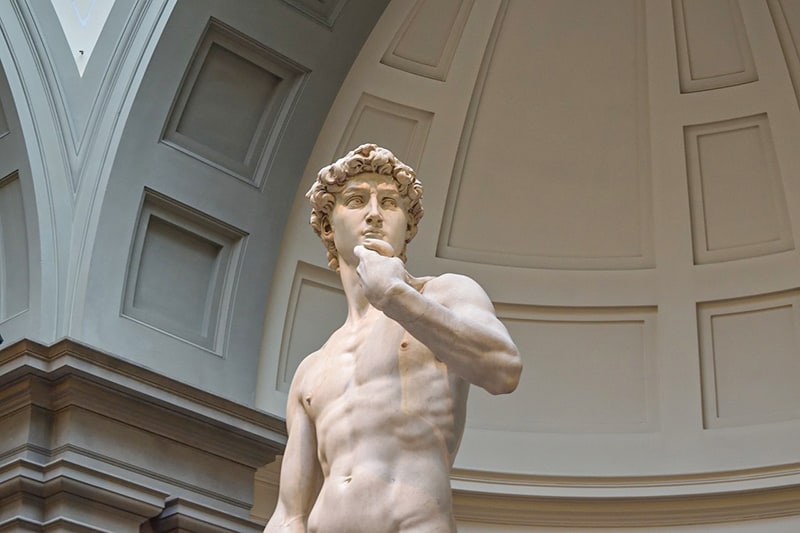
12. David (Michelangelo Buonarroti)
Renowned for capturing the contours and intricate crevices of mankind, the statue of David is a masterful triumph like no other. Michelangelo’s David depicts the well-known biblical story of David and Goliath.
The standing figure of David highlights the immense detail from the statue, from the chiseled abdominals to his seemingly pulsing veins. At 17 feet tall, David is almost three times the size of an average man.
Interestingly, David’s right hand is larger than his left hand. This is thought to be a deliberate nod to David’s nickname of manu fortis, meaning strong of hand.
You can see this imposing sculpture at the Accademia Gallery in Florence, Italy.
11. The Apollo Belvedere (after Leochares)
Nestled within the famous Vatican Museum in Rome, this marbled marvel was discovered in the 15th century. The masterpiece of the Renaissance period depicts the Greek god Apollo, the god of archery, poetry, and much more.
However, this famous sculpture is a Roman marble copy of a lost Greek bronze original, likely from the 4th century BCE.

10. Lincoln Memorial (Daniel Chester French)
A staple patriotic symbol of the USA, the Lincoln Memorial is located in Washington, DC. The statue of Abraham Lincoln, the 16th president of the United States, was constructed in honor of this great leader.
This 19-foot statue of Lincoln is an immense structure that was unveiled in 1922. It depicts Lincoln sitting in a large chair with a stoic yet determined expression.

9. The Gates of Hell (Auguste Rodin)
This artwork by French sculptor Auguste Rodin showcases phenomenal figures intertwined on a gate. The portal is inspired by Dante’s Inferno in the poem “The Divine Comedy”.
The bronze gate depicts seemingly distressed figures doomed to be stuck to the gate for eternity. With over 180 figures, this is an eye-catching sight to behold.
At the top of the gates, you’ll notice The Tree Shades. This sculptural group represent spirits of the dead. Directly below is The Thinker, originally named The Poet.
Although the monument was never cast in bronze during Rodin’s lifetime, you can now see versions of The Gates of Hell around the world. These include the Musée d’Orsay in Paris and the Rodin Museum in Philapdelphia to The Kunsthaus Zürich, Museo Soumaya in Mexico City, The Cantor Museum in Stanford University and The National Museum of Western Art in Tokyo.

8. The Winged Victory of Samothrace (Unknown)
This intriguing marble sculpture depicts a headless winged figure, represented as Nike, the Greek goddess of victory on the base of a ship. Discovered in fragments in 1863 by Charles Champoiseau on the island of Samothrace in Greece, the magnetism of this piece can still be felt despite it being incomplete.
Given pride of place at the top of the Daru staircase in The Louvre, The Winged Victory is a masterpiece of Greek Hellenic art. Thought to date from around 190 BC, the famous marble statue by an unknown artist has been restored several times.

7. Terracotta Army (Subjects of Qing Shi Huang)
Excavated close to the tomb of Qin Shi Huang, the Emperor of China in 220 BCE, these sculptures out of terracotta clay are an unbelievable sight. 8000-10,000 incredibly lifelike statues of soldiers were discovered in 1974 near the burial site to protect the emperor beyond the grave.
As well as armored warriors, there are also over 7,000 terracotta horses, chariots and weapons in the mausoleum. With additional figures, the total number of statues is around 40,000-60,000.
Located 26 miles from the city of Xi’an, The Museum of Terracotta Warriors and Horses is a must-see if you’re visiting China.

6. Psyche Revived by Cupid’s Kiss (Antonio Canova)
This romantic marble statue was constructed between 1787 and 1793. It depicts the Greek myth of Psyche and Cupid. A visual representation of the love story between these characters – Psyche is awakened by a kiss and reaches for Cupid.
The elegant sculpture epitomizes the Neoclassical focus on love and emotion. There are two versions of this famous statue – one is in the Louvre in Paris, and the other is in the Hermitage Museum in St Petersburg. A full scale model of the second version can be found in the Metropolitan Museum of Art in New York.

5. Cloud Gate (Anish Kapoor)
This masterpiece is often referred to as The Bean. A British artist, Anish Kapoor, constructed this statue in 2004. The striking art installation has quickly become one of the best photography spots in the windy city. It is also one of the biggest permanent art installations situated outdoors.
This silver, sensational structure captures the impressive panoramic view of the city skyline on its reflective surface. It is a great sight to add to a Chicago walking tour.

4. Manneken Pis (Jérôme Duquesnoy the Elder)
Located in the epicenter of Brussels, this iconic statue is among the smallest of the bunch and a little bizarre. This bronze statue is of a young boy urinating in a fountain.
One of the most famous statues in the world, the “Peeing Boy” has become an important symbol for the city. There are now other urinating statues in Brussels, including a dog and a young girl.
Fun fact: On special occasions, the city dresses this boyish rebellious figure in costumes. As such, his wardrobe comprises more than 900 suits.

3. Discus Thrower (Myron)
This famous artwork, also known as Discobolus, was originally cast in bronze and designed by Greek sculptor Myron. The amazing sculpture depicts a male athlete on the cusp of throwing a discus.
Dating from around 460–450 BC, the Discobulus of Myron exudes balance and body symmetry. Unfortunately, the original statue was lost over time.
However, various copies were made in Roman times before its disappearance. You can see one of these at The British Museum in London, UK and another at the Museo Nazionale Romano in Rome, Italy.

2. Statue of Liberty (Frédéric Auguste Bartholdi)
When traveling through iconic New York City, it’s hard to miss this mesmerizing statue. It is a symbol for democracy and freedom. The statue was a gift from France as a celebration of their friendship.
This immense national monument depicts a woman holding a torch and on the other a tablet. The tablet holds the date 07-04-1776, which is the implementation date of the Declaration of Independence in America.

1. Venus de Milo (Alexandros of Antioch)
Located within the Louvre Museum in Paris, the city of love, this carved marble art piece is rightfully placed. This chiseled beauty is said to represent Aphrodite of Milos, known as the Greek goddess of love and beauty.
The Venus de Milo statue dates to approximately 100 BCE. Though her missing arms are draped in an essence of mystery, this masterpiece is one of the most recognized sculptures from the classical Greek era.

Final Thoughts on the Most Famous Sculptures of All Time
These sculptures do not merely represent phenomenal artists and sculptors but lost and forgotten worlds. The remnants of the pasts enable individuals to glimpse into unimaginable histories. It is a physical link between the past and the present.
If you’re seeking more art inspiration, take a look at the most famous impressionist paintings and Surrealist artists to add to your must-see bucket list.
Interested in art? Check out these other articles:
- Best Sculpture Gardens in the World
- Best Virtual Art Tours
- Most Famous Impressionist Paintings
- Most Famous Painters in the World
Looking for more travel hacks and tips? From hidden gems to unique experiences, we’ve got you covered.
Join us on Facebook, Instagram, Pinterest and Twitter.
Like these famous sculptures? Pin for later or share with friends.


The photo of the statue depicted as the Little Mermaid doesn’t show the real statue but a rather coarse copy of the original. Easy to check out how the original little mermaid look on Google. Otherwise a fine article.
That’s really good to know, we’ll amend that part.