
From opulent royal residences to mighty fortresses, Italy’s palaces stand as enduring monuments to the country’s rich architectural heritage and noble history. These magnificent structures tell a unique story of power, artistry, and cultural evolution.
Let’s explore the most stunning palaces in Italy that continue to captivate visitors from around the world.
Each of these European palaces offers visitors a unique window into Italy’s rich cultural heritage, from the opulent lifestyles of its noble families to the architectural innovations that influenced buildings throughout Europe. Whether you’re an architecture enthusiast, history buff, or simply someone who appreciates beauty, these magnificent structures deserve a place on any Italian itinerary.
1. Royal Palace of Caserta
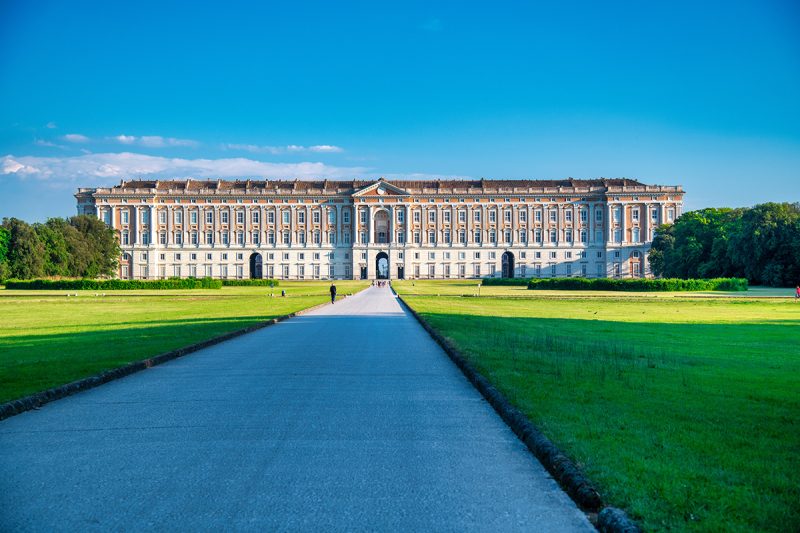
Often called the “Italian Versailles,” the Royal Palace of Caserta is a masterpiece of Baroque architecture and arguably Italy’s most magnificent royal residence. Commissioned by the Bourbon King Charles III in the 18th century, this UNESCO World Heritage site boasts 1,200 rooms adorned with precious artworks and frescoes.
The palace’s crowning glory is its spectacular gardens, featuring cascading fountains, elaborate sculptures, and a grand waterway stretching nearly two miles. The palace’s architect, Luigi Vanvitelli, created an ingenious system of aqueducts to supply water to the fountains and gardens, a remarkable feat of 18th-century engineering.
The Royal Apartments showcase the height of Neapolitan decorative arts, with silk wallpapers, intricate ceiling frescoes, and custom-made furniture still perfectly preserved. The palace’s grand staircase, with its marble steps and ornate statuary, remains one of the most impressive architectural features in any European palace.
2. Doge’s Palace, Venice
Venice’s iconic Doge’s Palace exemplifies the city’s unique Gothic architecture and maritime power. Overlooking St. Mark’s Square and the lagoon, this pink and white marble masterpiece served as both the Doge’s residence and the center of Venetian government for centuries.
Its ornate facades, golden staircases, and works by masters like Tintoretto and Veronese make it an unmissable treasure of Italian architecture. The palace’s famous Bridge of Sighs, connecting the palace to its prisons, has become one of Venice’s most photographed landmarks.
The Golden Staircase, adorned with 24-karat gold leaf and carved marble, leads to the Doge’s private apartments and state rooms. The Chamber of the Great Council, one of the largest rooms in Europe, features Tintoretto’s “Paradise,” the world’s largest oil painting.

3. Palazzo Pitti, Florence
Originally built for the powerful Pitti family and later home to the Medici dynasty, this massive Renaissance palace dominates Florence’s Oltrarno district. Today, it houses several museums showcasing everything from silver treasures to costume collections.
The palace’s Palatine Gallery contains an extraordinary collection of Renaissance and Baroque paintings, displayed in rooms decorated with elaborate frescoed ceilings and gilt furnishings.
The Royal Apartments preserve the sumptuous decorations from the period when the palace served as residence to the Kings of Italy. The palace’s unique rusticated stone facade, designed by Brunelleschi, influenced palace architecture throughout Europe.
The Boboli Gardens feature an amphitheater carved into the hillside, elaborate grottoes, and fountains that inspired many European royal gardens, including Versailles. Any Florence trip itinerary should include this exquisite palace.

4. Royal Palace of Turin
As the first capital of unified Italy, Turin’s Royal Palace represents the magnificent seat of the House of Savoy. Its lavish State Apartments feature rich baroque decorations, Chinese lacquer cabinets, and the stunning Chapel of the Holy Shroud.
The palace complex, part of a UNESCO World Heritage site, demonstrates the architectural grandeur of Europe’s oldest royal dynasty. The Royal Armory houses one of the world’s finest collections of arms and armour, while the Royal Library contains Leonardo da Vinci’s self-portrait and thousands of rare manuscripts.
The throne room, with its crimson damask walls and elaborate gilded stucco work, exemplifies the power and wealth of the Savoy dynasty. The Royal Gardens, recently restored to their original baroque splendor, provide a peaceful retreat in the heart of Turin.

5. Quirinal Palace, Rome
Sitting atop Rome’s highest hill, the Quirinal Palace serves as the official residence of the Italian President. Originally built for the papal court, this vast complex has housed kings and popes throughout its history.
Its elegant rooms, featuring priceless artworks and tapestries, showcase the evolution of Italian decorative arts across centuries. The Quirinal Gardens, designed in the 16th century, contain rare botanical specimens and ancient Roman statuary.
The massive Scala del Mascherino, a monumental staircase, demonstrates the architectural genius of the Renaissance. The Hall of Mirrors, inspired by its Versailles counterpart, reflects light from enormous Murano glass chandeliers.

6. Sforza Castle, Milan
This imposing fortress-palace stands as a symbol of Milan’s medieval power. Built by the Sforza dynasty, the building, also known as Sforzesco Castle, now houses several museums and art collections.
These include Michelangelo’s final sculpture, the Rondanini Pietà. Its massive walls and towers continue to dominate Milan’s historic center, bridging the city’s militant past with its cultural present.
The castle’s Sala delle Asse features Leonardo da Vinci’s remarkable ceiling decoration of interconnected trees and vines. The Ducal Chapel preserves some of the finest examples of Lombard Renaissance frescoes.

7. Royal Palace of Milan
Located in the heart of Milan facing the Duomo, this palace served as the seat of government for various rulers of the city, from Spanish governors to Austrian emperors. Its neoclassical rooms showcase elaborate decorations and furnishings, offering visitors a glimpse into Milan’s royal history.
The building’s facade, redesigned in the 18th century by Giuseppe Piermarini, creates a harmonious counterpoint to the Gothic cathedral opposite. The palace’s Sala delle Otto Colonne features remarkable marble columns and intricate mosaic floors.
The palace’s Hall of Caryatids, though damaged during World War II, remains one of Italy’s most impressive neoclassical interiors. The Royal Palace Museum houses important collections of decorative arts and period furniture.

8. Palazzo Carignano, Turin
This baroque masterpiece, now home to the Museum of the Risorgimento, played a crucial role in Italian unification as the seat of the first Italian Parliament. Its unique curved facade of red brick represents one of the finest examples of Baroque architecture in Piedmont.
The elaborate oval hall, where the first Italian parliament met, features original furnishings and decorations. Guarino Guarini‘s innovative architectural design combines traditional baroque elements with mathematical precision.
The palace’s grand staircase, with its unique elliptical shape, demonstrates the architect’s mastery of complex geometric forms. Whatever time you visit, the building’s intricate brickwork creates fascinating plays of light and shadow throughout the day.

9. Aragonese Castle, Ischia
Perched dramatically on a volcanic rock connected to Ischia by a stone bridge, this medieval castle combines natural and man-made fortifications to create one of Italy’s most striking coastal palaces. Its history spans over 2,500 years, housing everyone from noble families to religious orders.
The fortress includes a network of secret tunnels and passages used for defense and escape. The castle’s gardens offer breathtaking views of the Bay of Naples and the Amalfi Coast. They preserve rare plant species native to the island.

10. La Venaria Reale, Turin
This magnificent palace and gardens complex near Turin represents one of Europe’s largest royal residences. Recently restored to its former glory, the palace features stunning examples of Baroque architecture.
The Diana Gallery, decorated with hunting scenes, celebrates the Royal Venaria’s original purpose as a hunting lodge. The palace’s Church of Sant’Uberto, with its complex elliptical dome, represents a masterpiece of baroque sacred architecture.
La Venaria’s formal gardens rival those of Versailles. They feature contemporary art installations that complement the historic setting.

11. Miramare Castle, Trieste
Set against the azure waters of the Gulf of Trieste, this romantic 19th-century castle combines Gothic, Medieval and Renaissance styles. Built for Archduke Ferdinand Maximilian of Habsburg, its white limestone walls and clifftop location create one of Italy’s most picturesque palace settings.
The castle’s rooms retain their original furnishings, including Maximilian’s ship cabin recreation. The surrounding park features rare botanical species collected during the Archduke’s naval expeditions.

12. Valentino Castle, Turin
This elegant palace along the Po River showcases French-inspired architecture unique to the Piedmont region. Originally built as a villa for Christine of France, it now houses Turin’s Architecture Faculty while maintaining its historic gardens and royal apartments.
The castle’s exceptional frescoed galleries depict scenes from rural life and ancient mythology. The waterfront location made it a favorite summer residence for the Savoy court.

13. Doge’s Palace, Genoa
Now home to city offices and museums, Genoa’s Doge’s Palace reflects the maritime republic’s former glory. Its mix of medieval and Renaissance architecture, including the distinctive black and white striped facade, creates a striking presence in the heart of the city’s historic center.
The massive Tower Room hosted important diplomatic receptions and state ceremonies. The building survived significant damage during World War II and underwent extensive restoration.
The central courtyard, with its 16th-century fountain, remains a peaceful oasis in the bustling city.

If you’ve enjoyed reading about these beautiful palaces in Italy, check out our guide to the most breathtaking palaces in Europe too.
