
If you’re looking for a dose of surrealism, look no further than these famous Surrealist artists who have created some masterpieces of the genre. Their surrealist artworks will blow your mind with their creativity and ingenuity.
From Dali to Magritte, these painters created some of the most iconic and masterful pieces of surrealist art ever conceived. So if you’re in the mood for something a little different, take a look at these surrealist masterpieces!
History of Surrealism Art
The Surrealist art movement began around 1924 in Paris, France. It was born out of Dadaism as an attempt to move past the horrors of World War I and explore the unconscious mind.
Surrealism was initially founded by a group of artists who sought to redefine art and shake up the status quo. They wanted to create something new, something that would express their ideas about the world in a way that traditional art couldn’t.

Famous Surrealist Artists
Each of these artists is an expert of their craft. Their iconic paintings will leave you wondering about the Surrealist mindset. If you’re looking for something mind-blowing, take a look at these famous Surrealist painters and their masterpieces!
1. Salvador Dalí
Salvador Dali is one of the most famous surrealist painters in history, and for good reason. His painting The Persistence of Memory is one of the most iconic and recognizable pieces of art in the world.
The painting features melting clocks, which are meant to represent the fluidity of time. It’s a truly bizarre and fascinating work that will leave you mesmerized. View The Persistence of Memory in person at the Museum of Modern Art in New York City. It’s in the fifth-floor galleries – I’d recommend going on a weekday morning if you want to actually stand in front of it without a crowd three deep.
Dali’s 1937 painting The Metamorphosis of Narcissus is based on the Greek myth of Narcissus, who falls in love with his own reflection. This famous Surrealist work features a surreal landscape filled with strange creatures and distorted shapes.
Famous Salvador Dali artworks:
- The Persistence of Memory
- Metamorphosis of Narcissus
- Lobster Telephone

2. René Magritte
Another famous surrealist painter is René Magritte. His painting The Son of Man is one of the most well-known surrealist artworks in existence. The painting features a man with a bowler hat, which hovers just below eye level, so you can see a sliver of his eyes but not enough to recognize him. It’s that almost-but-not-quite reveal that makes the painting so unsettling. It stays with you.
Another iconic surrealist painting is René Magritte’s The Treachery of Images, which features a famous image of a pipe with the caption “This is not a pipe.” This painting challenges our perceptions and asks us to question what we see.
Famous Rene Magritte paintings:
- The Son of Man
- The Treachery of Images
- Golconda

3. Max Ernst
This German painter, poet and sculptor was a key member of the Dada and Surrealism movements. Despite having no formal art-school training, he invented the frottage and grattage techniques.
Frottage means rubbing in French. Ernst placed sheets of paper over textured objects and rubbed over them with a soft pencil.
With grattage, he placed a canvas covered in oil paint over a textured surface and then scraped off the paint. Both techniques are considered to be automatic methods of creative production.
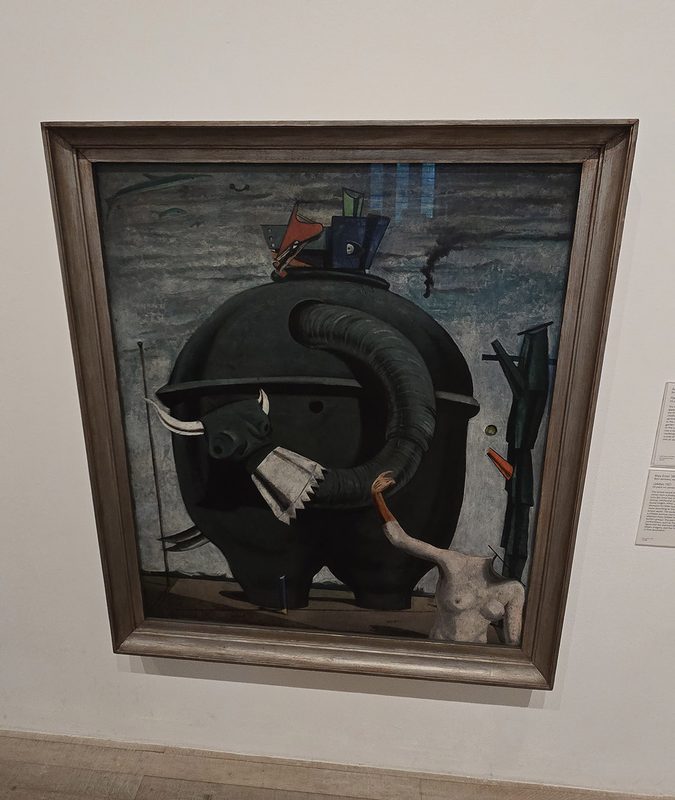
I was struck by the painting below which combines traditional painting with physical objects to recreate the irrational panic of a fever dream. The open barrier seems to draw you in to the artwork.
Famous Max Ernst paintings:
- The Elephant Celebes
- Two Children are Threatened by a Nightingale
- Forest and Dove

4. Yves Tanguy
Raymond Georges Yves Tanguy was a French Surrealist painter known for his abstract shapes and patterns. He was inspired by a painting by Giorgio de Chirico to become an artist, despite having no formal training.
In 1945, Tanguy moved to the United States, where he continued to paint until his death in 1955. His paintings are considered to be some of the most important examples of Surrealist art. They depict strange, dreamlike scenes that are full of symbolism and meaning.
Famous paintings by Yves Tanguy:
- Mama, Papa is Wounded!
- Extinction of Useless Lights
- Indefinite Divisibility

5. Joan Miró
A Spanish painter, ceramicist and sculptor, Joan Miró i Ferrà started his artistic training at an early age. He later moved to Paris, where he met other artists associated with the Surrealist movement.
His work was greatly influenced by his exploration of automatic drawing and dreams. Miro’s paintings are usually characterized by bright colors and simple shapes.
His use of geometric forms and repeating patterns give his work a distinctive look. He often used biomorphism, which is the use of organic shapes in his paintings.
Famous Joan Miro paintings:
- The Harlequin’s Carnival
- The Tilled Field
- Catalan Landscape

6. André Breton
Andre Breton was a French writer and poet who is considered the founder of Surrealism. He was very interested in exploring the subconscious mind and the power of dreams, and he believed that art should be a way to express these things. His Surrealist Manifesto laid out the philosophical foundation that painters like Dalí, Magritte, and Ernst built their work on. Without Breton’s ideas, the visual movement wouldn’t exist as we know it.
Some of Breton’s most famous works include the Surrealist Manifesto, which lays out the principles of the movement, and Nadja, a novel that tells the story of a surrealistic encounter between Breton and a young woman. Breton also played an important role in promoting Dadaism, another early avant-garde movement.
Despite his importance to the arts, Breton’s political beliefs sometimes put him at odds with other members of the Surrealist movement. He was a staunch communist, and many of his fellow Surrealists disagreed with his views. However, he remained an important figure in the movement until his death in 1966.
Famous Andre Breton literary works:
- Nadja
- The Magnetic Fields
- Surrealist Manifesto

7. Leonora Carrington
Mary Leonora Carrington OBE was born in England in 1917 and lived most of her life in Mexico City. She was a unique artist, famous for her Surrealist paintings that focus on women’s role in society.
Carrington’s art is characterized by its hallucinatory and dreamlike quality, which often incorporates animals and mythical creatures. Her paintings often depict scenes from her own life – animals, mythical creatures, and women caught in transformation – as well as her nightmares and hallucinations.
Carrington was also a writer, and her memoirs provide a fascinating glimpse into the surrealist movement. She remained active in the art world until her death in 2011. In her long and prolific career, she produced an astonishing body of work that has had a lasting influence on the art world.
Famous Leonora Carrington paintings:
- Self-Portrait: The Inn of the Dawn Horse
- Portrait of Max Ernst
- The Giantess (The Guardian of the Egg)

8. Man Ray
Man Ray was an American artist who is renowned for his contributions to the Surrealist movement. His birth name was Emmanuel Radnitzky. Man Ray was a painter, sculptor, photographer and filmmaker, and is considered one of the most important artists of the 20th century.
Ray’s work was heavily influenced by the Surrealist philosophy, which sought to blur the lines between reality and fantasy. He was known for his innovative and often surreal artwork, as well as his photography, which helped to promote the Surrealist movement.
Ray was an influential filmmaker and part of the Cinéma pur (pure cinema) avant-garde movement to return film to its origins of movement and vision. Ray’s visual arts creations have been exhibited all over the world and are held in many prestigious collections, including the Museum of Modern Art in New York and the Musée d’Orsay in Paris.
Famous Man Ray artworks:
- The Violin of Ingres
- Glass Tears
- Object to be Destroyed

9. Jean Arp
Hans Peter Wilhelm Arp, known as Jean Arp in English, was a French-German artist and poet. Arp was one of the first artists to embrace surrealism, and helped to define the movement.
His art is characterized by its playful, whimsical nature, and its focus on dreams and the unconscious mind. Arp was also a sculptor, and many of his works are considered some of the most important examples of surrealist sculpture.
Famous Jean Arp artworks:
- Idole
- Les Mains
- Torso-Profile

10. André Masson
André Masson was born in 1896 in a small town in northern France. He started painting at a very young age and showed great promise. In 1912, he moved to Paris and met the Surrealists.
Masson’s Surrealist paintings often feature dreamlike images and strange juxtapositions. He experimented with pouring glue and sand on canvas in his early works. The textures are rough, almost sculptural, with gritty surfaces that catch the light differently than traditional paint.
He was also a master of printmaking and produced some of the most striking prints of the era. Masson’s paintings and sculptures are characterized by their expressiveness and visual power.
He continued to produce powerful art until his death in 1987.
Famous Andre Masson artworks:
- Automatic Drawing
- In the Tower of Sleep
- Meditation on an Oak Leaf

11. Giorgio de Chirico
Giorgio de Chirico was an Italian artist born in Greece who is widely considered a precursor to Surrealism and the founder of Metaphysical painting. His dreamlike paintings of deserted town squares, created about 10 years before André Breton’s Surrealist Manifesto, were particularly appreciated by the Parisian Surrealist circle. In fact, André Breton chose de Chirico’s artwork The Dream of Tobias as the Surrealist group’s emblem.
De Chirico believed traditional themes could coincide with modern motifs, creating jarring juxtapositions of contemporary and Classical elements in vacant city squares. His best-known works often feature Roman arcades, long shadows, mannequins, trains, and illogical perspective.
His mysterious melancholy landscapes exhibit artificial realities centered on wistfulness, alienation, and dejection. These haunting cityscapes use simple brush strokes and somber hues to convey complex emotions about the tumultuous shift toward modernization in the early 20th century.
Famous Giorgio de Chirico artworks:
- The Enigma of an Autumn Afternoon
- The Song of Love
- The Mystery and Melancholy of a Street

12. Remedios Varo
Remedios Varo was a pioneering Spanish-Mexican Surrealist painter known for her intricate, dreamlike paintings that blend Renaissance allegory, mysticism, and psychology. Born in Spain in 1908, she fled war-torn Europe during World War II and settled in Mexico City, where she developed her unique artistic voice.
Varo’s meticulous paintings feature androgynous characters with facial features resembling her own, often caught in mystical journeys and encounters. Her work is characterized by juxtapositions of nature versus machine and feelings versus logic, creating multidimensional worlds where the woman artist, mystic, scientist, and spiritual being merge into one.
In Mexico, she formed a close friendship with fellow Surrealist Leonora Carrington, and the two collaborated on writing projects and drew from shared sources of inspiration. When she died suddenly in 1963 at age 54, André Breton described her as “the sorceress that left too soon.”
Famous Remedios Varo artworks:
- The Juggler (The Magician)
- Exploration of the Sources of the Orinoco River
- The Call

13. Dorothea Tanning
Dorothea Tanning was an American Surrealist painter, sculptor, and writer whose early works featured precise figurative renderings of dreamlike situations. Born in Illinois in 1910, she moved to New York in 1935 and became deeply embedded in the Surrealist movement after meeting Max Ernst in 1942.
Tanning’s paintings explore liminal spaces and transformations, with repeated motifs of doors, wallpaper, and cloth symbolizing thresholds where fantasy, reality, sensation, and imagination converge. Her work demonstrates a preoccupation with metamorphosis and the female experience, often depicting women caught in states of physical, emotional, or psychological transformation.
Tanning continued creating art, writing poetry and memoirs until her death in 2012 at age 101. Her body of work spanned more than seventy years and included painting, sculpture, fabric installations, costume and set designs, and a considerable body of poetry.
Famous Dorothea Tanning artworks:
- The Guest Room
- Birthday
- Eine Kleine Nachtmusik

14. Pablo Picasso
We know what you’re thinking, Picasso was more of a Cubist than a Surrealist. However, Picasso’s Les Demoiselles d’Avignon is often cited as the originator of cubism and surrealism.
The Tate art gallery also think so, as they included Picasso’s The Three Dancers in pride of place at their Surrealism Beyond Borders exhibition at Tate Modern, London.
Another painting by Picasso that has Surrealist elements is The Dream. This painting of Picasso’s young mistress is a representation of the subconscious mind. Picasso was known for using his own dreams as inspiration for his art.
Famous Pablo Picasso Surrealist paintings:
- Guernica
- Les Demoiselles d’Avignon
- Bird on a Tree

15. Meret Oppenheim
Meret Oppenheim was a German-born Swiss Surrealist artist whose fur-covered teacup became one of the most iconic symbols of the Surrealist movement. Born in Berlin in 1913, she moved to Paris at age 18 and quickly became embedded in the Surrealist circle through her friendship with Alberto Giacometti, who introduced her to Max Ernst, André Breton, and Man Ray.
Her work Object (a fur-covered teacup, saucer and spoon) became an overnight sensation at MoMA’s “Fantastic Art, Dada, Surrealism” exhibition in 1936, and the first artwork by a woman acquired by the Museum of Modern Art.
Over her lifetime, she created jewelry, sculpture, paintings, furniture, performance art, and poetry. She died in Basel in 1985.
Famous Meret Oppenheim artworks:
- Object (Fur-Covered Cup, Saucer and Spoon)
- My Nurse
- Squirrel

Other Artists Associated with Surrealism
Marcel Duchamp, who created the infamous Fountain (urinal) sculpture, was more of a Dadaist than a Surrealist but he helped to organize Surrealist exhibitions and knew many Surrealist artists. He believed that “An ordinary object [could be] elevated to the dignity of a work of art by the mere choice of an artist”.
The Mexican painter Frida Kahlo denied that she was a Surrealist, as her art was influenced by life events rather than dreams. However her artworks definitely have some surrealist elements.
Marcel Jean was a French painter, writer, and sculptor who joined the Surrealist movement in 1933. He is best known for his sculpture “Specter of the Gardenia” (1936), featuring a plaster head with zippers for eyes and a filmstrip collar, and his trompe l’oeil painting “Armoire Surrealiste.” A close friend of Marcel Duchamp, Jean also authored important books on the history of Surrealism, making him both a practitioner and chronicler of the movement.
French painter Francis Picabia, a close friend of Duchamp, was a leading Dadaist who clashed with Breton and mocked surrealism in his magazine 391, yet his dreamlike “Transparencies” paintings of the late 1920s and early 1930s, with their overlapping ghostly figures, are among the most surrealist-looking works of the period.

What is Surrealism?
Is Surrealism an artistic movement? A philosophy? A way of life?
Surrealism is all of these things and more. Defined by its founders, André Breton and Louis Aragon, as “the simultaneous awareness of the existence of two realities, the real and the imaginary,” surrealism is a movement that aims to liberate the creative potential of the subconscious mind.
Surrealism is not simply a matter of producing strange or bizarre images, but of exploring the full range of the human experience, including the irrational and the surreal. The aim of surrealism is to create art that reflects the inner world of the mind, free from the constraints of reason and logic.
Dalí’s melting clocks in The Persistence of Memory aren’t just weird for the sake of it – they’re showing how time feels in a dream, fluid and unstable rather than rigid and measurable.
Characteristics of Surrealist Artworks
One of the defining features of surrealism is its incorporation of elements that are not typically found in traditional art. These can include nonsensical images, random objects, and dreamlike scenarios.
Many surrealist artists drew inspiration from dreams, which they saw as a gateway to the subconscious. Surrealism has been credited with helping to usher in the era of abstract art. And its ideas about the subconscious mind have been hugely influential in the fields of psychology and psychiatry.
How to Recognize Surrealist Art in a Museum
Not sure if a painting you’re looking at counts as surrealism? A few visual clues to watch for: objects that don’t belong together in the same frame (a lobster on a telephone, a bowler hat floating in front of a face), hyper-realistic detail painted in an illogical arrangement, empty or impossible landscapes, and recurring symbols like clocks, mirrors, eggs, and doors.
Surrealist paintings tend to feel dreamlike but are often painted with technical precision – the weirdness is in what’s shown, not how it’s painted. Once you start noticing these patterns, you’ll spot surrealism everywhere, even in artists who weren’t officially part of the movement.
You can find many surrealist artworks in Tate Modern, London. Their dedicated display, International Surrealism, remains on long-term free view following thematic rehangs emphasizing transnational connections.
Where to See the Most Surrealist Art in One Trip
If you want to see surrealism’s greatest works in person, four cities stand out: New York, Barcelona, Paris and Mexico City. Each has a different strength, so the best choice depends on which artists you love most.
New York: The Biggest Masterpieces Under One Roof
MoMA is the best single museum for surrealism anywhere. Dalí’s The Persistence of Memory, Meret Oppenheim’s fur-covered teacup and Max Ernst’s Two Children Are Threatened by a Nightingale all hang in the same building. Major works by Magritte and Miró are there too.
Add the Met’s modern art galleries and you can see an extraordinary amount in a long weekend.
Barcelona: The Most Immersive Surrealist Trip
Barcelona is the best base if you want to go beyond paintings on a wall. The Fundació Joan Miró on Montjuïc hill was set up by the artist himself and holds one of the largest Miró collections in the world.
From Barcelona, the high-speed train reaches Figueres in under an hour. That’s where you’ll find the Dalí Theatre-Museum, which Dalí designed himself and where he is buried.
Extend the trip to Púbol Castle and Dalí’s seaside house at Portlligat near Cadaqués. Together with Figueres, these make up the “Dalí Triangle”. Book Portlligat well ahead, as visits run in small timed groups.
Paris: Where It All Began (With a Caveat)
Paris is where Breton launched the movement in 1924, but there’s an important catch for anyone planning a trip now. The Centre Pompidou, home to France’s national modern art collection, shut in September 2025 for a major renovation and is due to reopen in 2030.
In the meantime, the Grand Palais is hosting the Pompidou’s major exhibitions while the building is closed. Combine it with Dalí Paris in Montmartre and the Musée Picasso.
For more surrealism, the Magritte Museum in Brussels is an easy add-on by train from Paris, or direct from London on the Eurostar.
Mexico City: Surrealism’s Second Home
Leonora Carrington and Remedios Varo both made their lives in Mexico City after fleeing wartime Europe. The Museo de Arte Moderno in Chapultepec Park holds work by both artists. Carrington’s former home in Colonia Roma is now open to visitors as Casa Estudio Leonora Carrington.
Frida Kahlo’s Casa Azul in Coyoacán completes the trip, and you’ll need to book tickets online in advance. If you have extra days, Edward James’s surreal jungle garden, Las Pozas in Xilitla, makes an unforgettable extension.
Which city should you choose? For the most famous masterpieces in a single museum, go to New York. For the most immersive surrealist experience, Barcelona and the Dalí Triangle are hard to beat.

How Surrealism Influenced Later Art Movements
Surrealism faded as an organized movement after World War II, but its ideas never went away. Its love of strange objects, dream logic and the unconscious shaped much of the art that came after it.
Pop Art
Claes Oldenburg’s soft sculptures, such as Soft Toilet (1966), turn everyday objects into something slumped and unsettling. They owe a clear debt to Dalí’s melting clocks and Oppenheim’s fur teacup.
Magritte’s influence reached pop culture too. In the 1960s Paul McCartney bought a Magritte painting of a green apple, and it inspired the Apple Records logo.
Contemporary Installation Art
Louise Bourgeois moved in Surrealist circles in Paris and New York before creating her own dreamlike, psychological sculptures. Her giant spider, Maman, has a permanent cast outside the Guggenheim Bilbao.
Yayoi Kusama’s Infinity Mirror Rooms carry the surrealist idea of stepping inside a dream into immersive installation. Kusama has spoken about drawing on hallucinations she has experienced since childhood.
The influence runs through luxury fashion as well. Elsa Schiaparelli’s 1937 lobster dress was designed with Dalí, and the house of Schiaparelli still uses surrealist motifs today.
Contemporary Surrealist Artists Working Today
Surrealism didn’t end in the mid-20th century. Several living artists are carrying its spirit into the present day.
Jacek Yerka
Polish painter Jacek Yerka, whose real name is Jacek Kowalski, was born in Toruń in 1952. His meticulously detailed landscapes turn houses, rivers and kitchens into impossible dreamworlds. Critics often compare his precise technique to old masters such as Bosch and Bruegel, and to surrealists like Dalí and Magritte.
He won the World Fantasy Award for best artist in 1995. He paints only around eight new works a year, and his original acrylics sell for more than €100,000.
Mark Ryden
American artist Mark Ryden is one of the leading names in “Pop Surrealism”, a movement that blends surrealist dream imagery with kitsch and pop culture. His paintings mix wide-eyed girls, cuts of meat and historical figures with a polished, old-master finish.
You may already know his work without realizing it. He painted the cover of Michael Jackson’s 1991 album Dangerous.
In Conclusion: Famous Surrealist Artists
Surrealism is a challenging and often enigmatic art form that defies easy explanation. It is an approach to art that is as much a way of life as it is a style or movement. To truly understand surrealism, you need to experience it firsthand. So go ahead, unleash your inner Surrealist!
If you enjoyed learning about these famous Surrealist artists, be sure to check out our other posts on famous Impressionist painters and the best sculptures worldwide. We’ve got a wide range of articles that are perfect for any art lover or history buff.
Like this guide to the most famous Surrealist artists? Pin for later or share with friends.

Frequently Asked Questions About Surrealist Art
Who is the most famous surrealist artist?
Salvador Dalí is widely considered the most famous surrealist artist. His iconic melting clocks in “The Persistence of Memory” and theatrical personality made him a household name.
While André Breton founded the movement and René Magritte created equally brilliant work, Dalí’s self-promotional genius and instantly recognizable style cemented his position as surrealism’s most celebrated figure.
What are the key characteristics of surrealist art?
Surrealist art combines realistic painting techniques with impossible, dreamlike scenarios. Key characteristics include unexpected juxtapositions (like a lobster on a telephone), metamorphosis of objects or bodies, distorted scale and perspective, symbolic imagery drawn from dreams and the subconscious, and automatism (creating without conscious thought).
You’ll often see floating objects, strange creatures, vast empty landscapes, and scenarios that feel familiar yet deeply unsettling.
Where can I see surrealist art in person?
The best museums for surrealist art include the Dalí Theatre-Museum in Figueres, Spain, the Magritte Museum in Brussels, Belgium, and MoMA in New York City, which houses major works by Dalí, Magritte, and Ernst. The Tate Modern in London and Philadelphia Museum of Art also have outstanding surrealist collections.
The Salvador Dalí Museum in St. Petersburg, Florida holds the largest collection of Dalí’s work outside Europe.
Who founded the surrealist movement?
André Breton founded the surrealist movement in 1924 when he published the Manifesto of Surrealism in Paris. The French writer and poet defined surrealism as ‘pure psychic automatism’ and served as the movement’s unofficial leader and enforcer.
Breton was notorious for excommunicating artists who didn’t follow his vision – he even expelled Salvador Dalí from the group in 1934, though it did nothing to slow Dalí’s career.
What’s the difference between Surrealism and Dadaism?
Dadaism (1916-1924) was anarchic, anti-art, and purely destructive – it rejected logic, reason, and aesthetics in response to World War I. Surrealism (1924-1940s) evolved from Dada but was constructive rather than destructive.
While Dada said ‘art is meaningless,’ surrealism said ‘let’s explore the unconscious mind to find deeper meaning.’ Surrealists used technical skill and Freudian theory to create dreamlike imagery, whereas Dadaists embraced randomness, collage, and readymades to mock the art establishment.
Read next:
